






What's Happening?
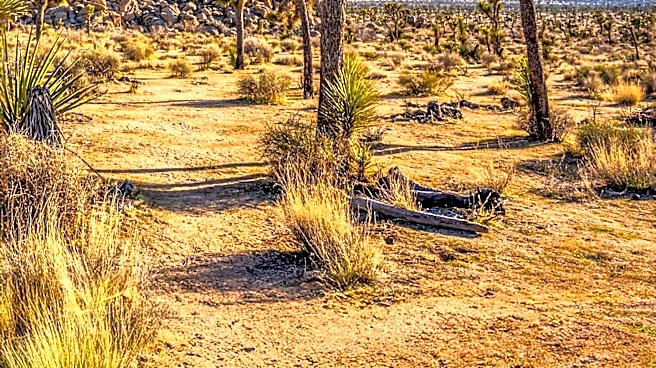
Joshua Tree National Park is characterized by the convergence of two distinct desert environments: the lower Colorado Desert and the higher Mojave Desert. Visitors entering from the south will first encounter the Colorado Desert, which features broad
desert country with shrubs, ocotillo canes, and dense gatherings of cholla cacti, such as those found in the Cholla Cactus Garden. As one travels to higher elevations, the landscape transitions into the Mojave Desert, where the iconic Joshua trees become prevalent alongside rounded granite boulders, creating scenes like those at the Hall of Horrors. The National Park Service emphasizes that while these two deserts have distinct characteristics, there is an overlap in species distribution, and the transition is not marked by a precise boundary line. Elevation plays a significant role in these ecological differences, with higher terrain generally being cooler, influencing plant life and overall scenery.
Why It's Important?
The unique ecological diversity of Joshua Tree National Park, stemming from the meeting of the Colorado and Mojave deserts, is crucial for biodiversity and scientific study. This natural phenomenon allows for a wide range of plant and animal species to thrive, some of which are unique to these specific desert conditions. Understanding the transition zones and the factors influencing plant distribution, such as elevation and moisture timing, provides valuable insights into desert ecology and adaptation. The park's distinct landscapes also offer significant educational opportunities for visitors, fostering a greater appreciation for natural environments and the delicate balance of ecosystems. The visual contrast between the two deserts, from cholla gardens to Joshua tree-filled uplands, enhances the visitor experience and highlights the complexity of natural boundaries.
What's Next?
Visitors to Joshua Tree National Park are encouraged to explore the diverse landscapes by planning their routes to experience both the Colorado and Mojave deserts. The park suggests starting from the Cottonwood area, continuing north on Pinto Basin Road past the Cholla Cactus Garden, and then turning west onto Park Boulevard toward the Hall of Horrors to observe the ecological transition. Future efforts will likely continue to focus on educating the public about the park's unique dual desert ecosystem and the importance of preserving its natural integrity. This includes emphasizing that the change between deserts is gradual rather than abrupt, encouraging visitors to observe the subtle shifts in vegetation and terrain. Ongoing research and conservation initiatives will also likely monitor the health of these distinct ecosystems and the species within them.
Beyond the Headlines
The ecological transition within Joshua Tree National Park offers a profound lesson in the fluidity of natural boundaries and the interconnectedness of ecosystems. The idea that nature does not adhere to rigid lines, but rather presents gradual changes and overlaps, challenges simplistic understandings of environmental divisions. This perspective can influence broader discussions on conservation strategies, emphasizing the need to protect entire ecological gradients rather than isolated areas. Culturally, the park's diverse landscapes inspire artists, photographers, and nature enthusiasts, contributing to its status as a significant natural landmark. The ongoing study of how species adapt and thrive in these transitional zones also provides critical data for understanding resilience in the face of environmental changes, including climate shifts, making the park a living laboratory for ecological research.