




What's Happening?
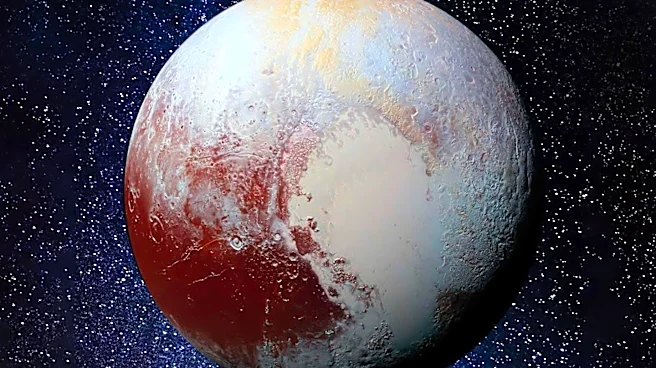
In 2006, the International Astronomical Union (IAU) established a definitive set of criteria for classifying a celestial body as a planet. According to the IAU, a planet must (1) orbit the Sun, (2) have sufficient mass to assume a nearly round shape,
and (3) have cleared its orbit of other objects. Pluto, while meeting the first two criteria, fails the third because it shares its orbital region with many other Kuiper Belt objects. Consequently, Pluto was reclassified as a dwarf planet. This decision was prompted in part by the discovery of Eris, another celestial body of comparable size to Pluto, which necessitated a clearer definition of planetary status.
Why It's Important?
The IAU's 2006 reclassification of Pluto and the establishment of clear planetary criteria had a significant impact on astronomy and public understanding of our solar system. It provided a more rigorous scientific framework for categorizing celestial bodies, moving beyond historical conventions. This redefinition helps scientists better understand the formation and evolution of planetary systems by distinguishing between major planets that dominate their orbital paths and smaller bodies that coexist in crowded regions. For the public, it sparked widespread discussion and a renewed interest in space science, highlighting the dynamic nature of scientific knowledge and classification.
What's Next?
The IAU's definition continues to be the standard for classifying planets within our solar system. While there are ongoing discussions and discoveries of new celestial bodies, any future reclassifications or additions to the planetary roster would likely adhere to these established criteria or necessitate a formal re-evaluation by the IAU. The ongoing exploration of the Kuiper Belt and beyond, through missions and observatories, will continue to uncover new objects, further testing and refining our understanding of the solar system's architecture and the characteristics that define its various inhabitants.
Beyond the Headlines
The debate surrounding Pluto's reclassification extends beyond mere nomenclature; it touches upon the very essence of scientific categorization and the process by which scientific consensus is reached. It illustrates that scientific definitions are not static but evolve with new discoveries and improved understanding. The public's emotional attachment to Pluto as a planet also highlights the cultural dimension of scientific concepts. This event serves as a powerful example of how scientific bodies grapple with new data and strive for precision, even when it means challenging long-held beliefs and popular perceptions.