





What's Happening?
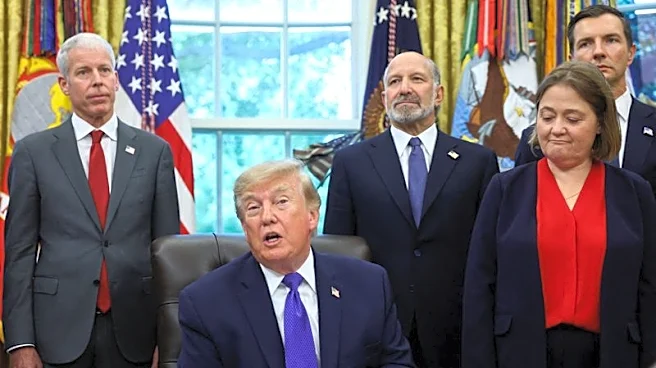
On September 16, 2026, President Trump issued a Presidential Memorandum titled 'Restoring Reciprocity in Government Procurement,' aiming to exclude Canadian-origin items from the U.S. federal procurement system. The Memorandum instructs the Office of
Management and Budget (OMB) Director and the U.S. Trade Representative, in coordination with the FAR Council, to identify and take all legally permissible steps to remove or make unavailable Canadian-origin items in federal civil procurement. Additionally, the OMB Director is tasked with notifying relevant executive departments and agencies of domestic alternatives to Canadian-origin items. This directive follows an escalation in U.S.-Canadian economic tensions, partly attributed to Canadian procurement actions taken in response to U.S. tariff measures. The Memorandum suggests that these directives could be rescinded if Canada alters its policies. The specific criteria for determining a good as 'Canadian origin' within the U.S. federal procurement system have not been clarified.
Why It's Important?
This Presidential Memorandum carries significant implications for U.S. trade relations and procurement policies. The U.S. and Canada are both signatories to the World Trade Organization Government Procurement Agreement (WTO GPA), a multilateral trade agreement designed to promote transparency and market access in government procurement among its members. Under the WTO GPA, the U.S. is generally obligated to treat Canadian goods and services as favorably as its own, prohibiting origin-based discrimination in covered procurements. The Memorandum explicitly states that actions should be taken 'to the extent permitted by existing law,' raising questions about how these directives will align with U.S. obligations under the WTO GPA. The Trump Administration has previously invoked security exceptions to trade agreements, suggesting a potential avenue for justifying these measures. This move could disrupt established supply chains and increase costs for federal agencies if they are forced to source more expensive domestic alternatives. It also signals a hardening stance in U.S. trade policy, potentially leading to retaliatory measures from Canada and further strain on bilateral economic ties.
What's Next?
The immediate next steps involve the OMB Director and the U.S. Trade Representative identifying specific Canadian-origin items and implementing measures to remove them from the federal procurement system, all while navigating existing legal frameworks and international trade obligations. The U.S. government will need to clarify how these actions will be reconciled with its commitments under the WTO GPA, potentially through invoking exceptions or reinterpreting existing agreements. Canada's response to this directive will be crucial; the Memorandum itself indicates that the directives could be rescinded if Canada changes its procurement policies, particularly its 'Buy Canadian' policy implemented in December 2025. Businesses involved in U.S. federal procurement, especially those with Canadian supply chains, will need to monitor these developments closely to understand potential impacts on their contracts and operations. The situation could lead to further trade disputes and negotiations between the two countries, potentially affecting various sectors of their economies.
Beyond the Headlines
The Presidential Memorandum highlights a deeper tension between national economic protectionism and multilateral trade agreements. While the stated goal is 'Restoring Reciprocity,' the directive could be perceived as a unilateral action that undermines the spirit of international cooperation embedded in agreements like the WTO GPA. The ambiguity surrounding the legal justification for these actions, particularly in light of existing trade obligations, could set a precedent for future trade disputes where national interests are prioritized over international commitments. This approach could encourage other nations to adopt similar protectionist measures, leading to a fragmentation of global trade systems. Furthermore, the focus on 'Canadian origin' items without clear definitions could create administrative complexities and legal challenges for both government agencies and private sector entities. The long-term implications extend beyond immediate economic impacts, potentially reshaping the landscape of international trade law and the role of multilateral institutions in regulating global commerce.