





What's Happening?
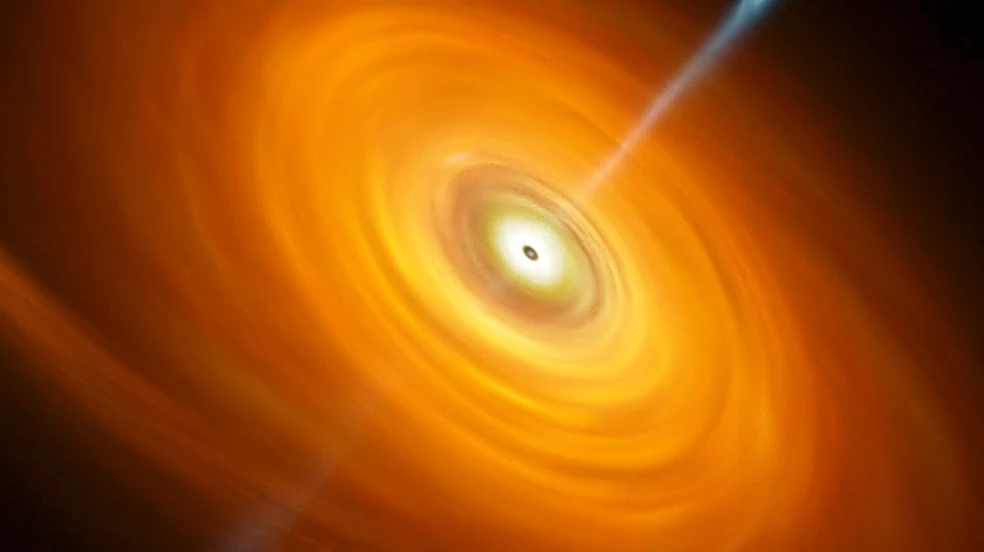
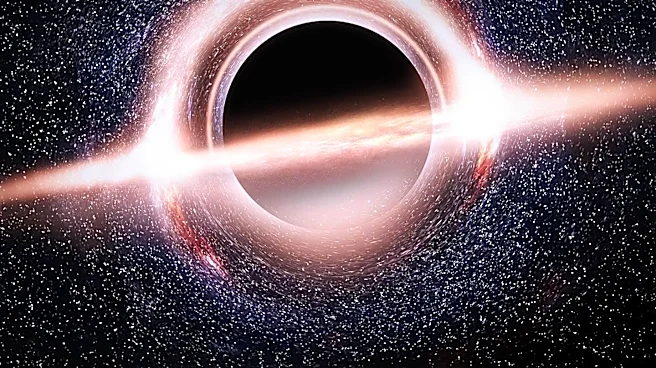
An international team of physicists from the University of Southern Denmark, the University of Naples Federico II, and the CNRS–Sorbonne Université laboratory LPTHE has published research in Physical Review D exploring the theoretical possibility of a black
hole splitting into two. Standard interpretations of Einstein’s general relativity fundamentally forbid such an event due to the principle of entropy, which dictates that a single large black hole possesses more entropy than two smaller ones of equivalent total mass, making a spontaneous split thermodynamically unfavorable. Stephen Hawking’s classical area theorem further reinforces this by stating that the area of an event horizon cannot decrease under normal conditions. However, the new study investigates specific conditions and theoretical loopholes that might permit such a division, focusing on the role of rotation. The researchers modeled scenarios where a rapidly spinning black hole could shed its angular momentum into the orbital motion of two resulting fragments, potentially allowing the total entropy of the system to remain stable or increase. This would require the parent black hole to be spinning near its theoretical maximum limit, and the fragment would need sufficient kinetic energy to escape its gravitational pull.
Why It's Important?
This research is important because it pushes the boundaries of our understanding of black holes and the fundamental laws of physics, particularly Einstein's general relativity. If black holes could theoretically split, even under extreme conditions, it would challenge long-held assumptions about spacetime and entropy. The study's exploration of 'pair-of-pants topologies' and the role of rotation introduces new avenues for theoretical physics, suggesting that our current models might be incomplete or require refinement. While the conditions for such an event are highly specific and likely rare in typical astrophysical environments, the investigation into these possibilities helps to define the limits of what is physically possible. It also encourages a deeper look into higher-dimensional physics and alternative theories of gravity, which might offer different mathematical solutions where fragmentation is favored. This theoretical work could guide future observational efforts, as any unique Hawking radiation patterns from such events, particularly from primordial black holes or smaller fragments, could be detectable by observatories like Fermi-LAT.
What's Next?
The study primarily serves as a theoretical framework, defining the boundaries of what might be possible under extreme conditions and highlighting potential gaps in our current understanding of gravity. Future research will likely continue to explore these theoretical loopholes, potentially incorporating higher-curvature corrections or adjusting mass-entropy relationships in mathematical models to see if fragmentation becomes more plausible. The authors suggest that if such events were to occur, particularly with primordial black holes or smaller fragments, they might leave behind unique Hawking radiation patterns. This opens the door for future observational astronomy to search for these specific signatures, although the study itself does not claim to have discovered a mechanism for black hole fission. The work encourages a continued dialogue within the scientific community about the behavior of spacetime and matter under conditions that challenge established physical laws, potentially leading to new insights into the nature of black holes and the universe.
Beyond the Headlines
The concept of a black hole splitting, while currently theoretical and highly constrained, delves into profound ethical and philosophical implications regarding the nature of existence and the limits of physical laws. If such an event were possible, it would imply a breakdown in the predictability of spacetime, potentially leading to the formation of a 'naked singularity'—a point of infinite density not hidden behind an event horizon. This challenges the cosmic censorship hypothesis, a fundamental principle in general relativity that states singularities should always be hidden. The study's exploration of how our laws of physics might need to change to allow for such phenomena underscores the dynamic and evolving nature of scientific understanding. It highlights that even well-established theories like general relativity are subject to scrutiny and refinement when confronted with extreme theoretical possibilities. This continuous questioning and exploration of the universe's most enigmatic objects, like black holes, not only advances scientific knowledge but also expands our conceptual framework for understanding reality itself.