
What's Happening?
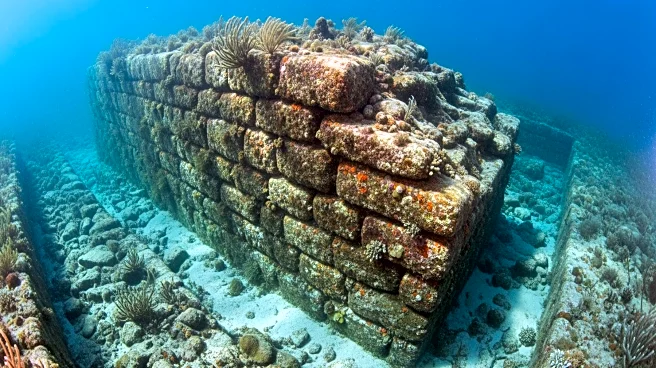
An ancient undersea wall dating back to 5,800 BC has been discovered off the coast of Brittany, France. The 120-meter-long structure, along with a dozen smaller manmade structures, was found near the Ile
de Sein. The discovery was made by divers who explored the site between 2022 and 2024, confirming the presence of granite structures initially spotted by retired geologist Yves Fouquet in 2017. These structures, lying nine meters underwater, were built when sea levels were much lower. Researchers suggest they may have served as fish traps or protective walls against rising seas, reflecting advanced technical skills and social organization of coastal societies at the time.
Why It's Important?
This discovery provides new insights into the capabilities and social structures of prehistoric coastal societies. The technical skills required to construct such large stone structures predate known megalithic constructions by several centuries, indicating a sophisticated level of organization and engineering. Understanding these ancient societies can offer valuable perspectives on human adaptation to environmental changes, such as rising sea levels, which remain relevant today. The find also opens new avenues for underwater archaeology, potentially leading to further discoveries that could reshape our understanding of prehistoric human activity.