
What's Happening?
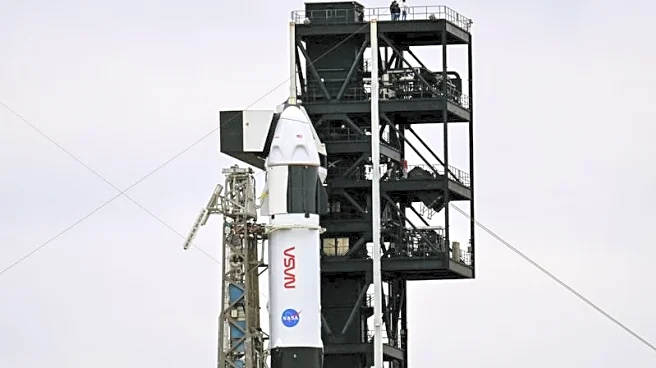
NASA's Artemis 2 mission, which aims to send astronauts to the far side of the moon, has encountered a delay due to a hydrogen fuel leak. The Artemis 2 Space Launch System (SLS) rocket, along with the Orion
spacecraft, was undergoing a wet dress rehearsal on February 3, 2026, when the leak was discovered. This rehearsal involved fully loading the rocket with propellant to identify and fix potential issues before the actual launch. As a result of the leak, the launch has been postponed to no earlier than early March 2026. The mission is set to carry NASA astronauts Reid Wiseman, Victor Glover, Christina Koch, and Canadian Space Agency's Jeremy Hansen on a historic 10-day mission. The Artemis 2 rocket is noted for its power, boasting 8.8 million pounds of thrust, surpassing the Saturn V rocket used during the Apollo missions.
Why It's Important?
The delay of the Artemis 2 mission is significant as it impacts NASA's timeline for returning humans to the moon, a key objective of the Artemis program. This mission is crucial for testing the systems needed for future lunar exploration and establishing a sustainable human presence on the moon. The delay could affect subsequent missions and the overall schedule of the Artemis program, which aims to land the first woman and the next man on the moon by the mid-2020s. The successful execution of Artemis 2 is vital for maintaining momentum and public support for NASA's lunar exploration goals. Additionally, the mission involves international collaboration, with Canadian astronaut Jeremy Hansen participating, highlighting the global interest and cooperation in space exploration.
What's Next?
NASA will need to address the hydrogen fuel leak issue before proceeding with the Artemis 2 launch. Engineers will likely conduct further tests and repairs to ensure the rocket's readiness. Once resolved, the mission will proceed with its planned launch, carrying the crew on a 10-day journey around the moon. The outcome of this mission will inform the planning and execution of future Artemis missions, including Artemis 3, which aims to land astronauts on the lunar surface. Stakeholders, including international partners and the scientific community, will be closely monitoring the developments, as the success of Artemis 2 is pivotal for the future of lunar exploration.