

What's Happening?
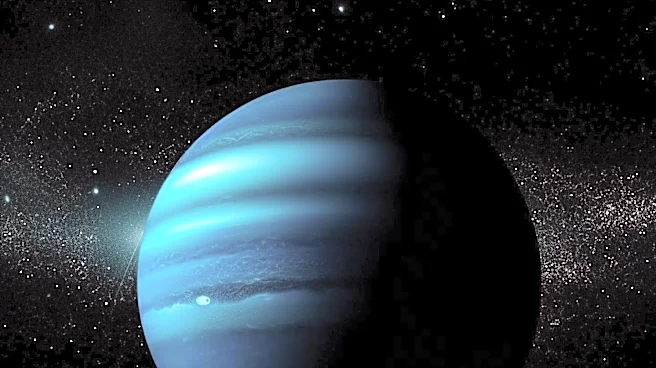
Astronomers utilizing the Planet Finder Spectrograph (PFS) on the 6.5-meter Magellan Clay Telescope have discovered a massive, cold gas giant exoplanet, HIP88962 b, orbiting the K7V dwarf star HIP88962. This exoplanet has an orbital period of approximately
19.3 years, a true planet mass of 4.83 Jupiter masses, a semimajor axis of 6.15 astronomical units (AU), and a highly eccentric orbit with an eccentricity of 0.718. The discovery was made through 16 years of PFS observations, combined with astrometric data from Hipparcos and Gaia satellites, which helped determine the planet's true mass and orbital inclination. The host star, HIP88962, is a K7V dwarf with a mass of 0.62 solar masses, located 27.3 parsecs from Earth. The research team also noted signs of stellar activity in HIP88962, which may contribute to some of the observed radial velocity variations.
Why It's Important?
The existence of HIP88962 b significantly challenges conventional theories of gas giant planet formation, particularly the core accretion model. This model struggles to explain the formation of such a massive gas giant at a relatively large orbital distance (6.15 AU) around a low-mass star (0.62 solar masses), especially with such high eccentricity. Population synthesis models based on core accretion predict a dramatic decrease in gas giant formation around stars with masses below 0.5 solar masses, and typically do not form planets of this mass and orbital distance. The discovery lends stronger support to the alternative theory of gas disk gravitational instability (GDGI), which proposes that gas giants can form directly from the collapse of dense regions within protoplanetary disks. This finding suggests that GDGI may be a more prevalent mechanism for planet formation around low-mass stars than previously thought, expanding our understanding of planetary system diversity.
What's Next?
Future observations are crucial to further refine the orbital parameters of HIP88962 b and to search for additional planets in the system. Continued radial velocity monitoring will help clarify the exoplanet's orbit and potentially confirm the presence of other planetary companions, which were hinted at by residuals in the initial single-planet fit. The study also highlights the need for more comprehensive population synthesis models that incorporate both core accretion and gas disk gravitational instability to fully explain the observed diversity of exoplanets. As astronomical instruments advance, particularly with ongoing Gaia astrometry, more discoveries of cold gas giants around low-mass stars are anticipated, which will further test and refine current planet formation theories. These future detections will contribute to a more universal model of exoplanet formation.
Beyond the Headlines
This discovery has profound implications for our understanding of planetary habitability and the prevalence of different types of planetary systems. If gas disk gravitational instability is a more common formation mechanism, it could mean that massive planets can form in a wider range of stellar environments, including around smaller, cooler stars. This could influence the distribution of planetary architectures and the potential for life in the galaxy. The high eccentricity of HIP88962 b's orbit also raises questions about the dynamical evolution of planetary systems, suggesting that gravitational interactions or scattering events may play a significant role in shaping the final orbits of planets. The ongoing challenge to reconcile observational data with theoretical models underscores the dynamic and evolving nature of exoplanetary science, pushing the boundaries of our cosmic understanding.