
What's Happening?
Researchers at the University of Vienna have conducted an experiment that extends the known limits of quantum mechanics to larger scales than previously observed. The team, led by Sebastian Pedalino, used
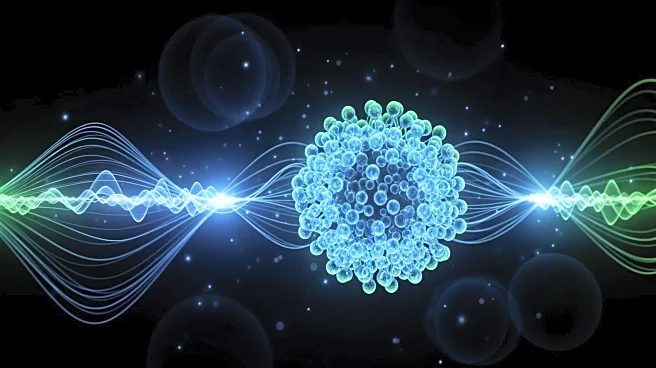
sodium nanoparticles, each containing over 7000 atoms, to demonstrate quantum superposition states. This experiment revealed an interference pattern, indicating that these nanoparticles exist in a Schrödinger’s cat-like state, where they are in two positions simultaneously. The study achieved a macroscopicity score of 15.5, marking a significant increase in the 'size' of observed quantum effects, comparable to the size of a large virus. This advancement challenges the traditional view that quantum effects are limited to the microscopic realm and suggests that quantum mechanics can apply to larger, more macroscopic objects.
Why It's Important?
This breakthrough has significant implications for both theoretical physics and practical applications. By demonstrating quantum effects in larger objects, the research challenges existing theories about the boundary between quantum and classical physics. It suggests that quantum mechanics may not have a strict size limit, prompting a reevaluation of how quantum principles apply to the macroscopic world. Practically, this could lead to advancements in quantum technologies, such as quantum computing and simulation, by preserving quantum states in larger systems. The findings also provide a new framework for exploring subtle forces and interactions at scales previously thought inaccessible, potentially leading to new discoveries in material science and nanotechnology.
What's Next?
Future research will likely focus on further increasing the macroscopicity of objects exhibiting quantum effects. Pedalino and his team aim to replicate their experiment with larger biological objects, such as viruses, to explore quantum superpositions at even greater scales. This could provide insights into the fundamental nature of quantum mechanics and its applications in technology. Additionally, the study opens the door for developing new quantum technologies that leverage the quantumness of macroscopic objects, potentially revolutionizing fields like computation and simulation. Researchers will continue to refine their techniques to observe quantum effects in increasingly larger and more complex systems.