







What's Happening?
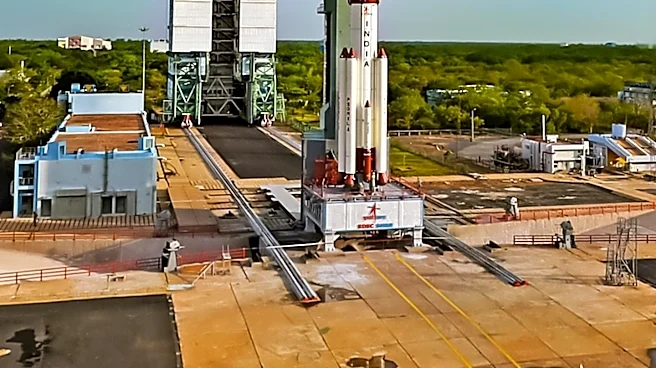
India successfully launched its NVS-03 satellite aboard a GSLV Mark II rocket from the Satish Dhawan Space Centre on October 30, at 2:21 p.m. EDT. This mission marks the 14th launch for the GSLV Mark II, with 12 successful liftoffs to date. The NVS-03 is the third
next-generation satellite for India's Navigation with Indian Constellation (NavIC) system, which is India's regional equivalent to the United States' Global Positioning System (GPS). The Indian Space Research Organisation (ISRO) confirmed the rocket deployed NVS-03 into geostationary transfer orbit as planned. NavIC is designed to provide accurate Position, Navigation, and Timing (PNT) services to users in India and within a 1,500 km (930 miles) radius beyond its landmass. The current Indian constellation has three fully functioning satellites, and four are required to provide full PNT services, making this launch crucial for the system's operational capability.
Why It's Important?
The successful launch of NVS-03 is a significant step for India's self-reliance in satellite navigation technology. By strengthening its NavIC system, India reduces its dependence on foreign-controlled navigation systems like the U.S. GPS, which can be critical for national security, defense, and strategic autonomy. A robust indigenous navigation system provides India with independent control over its positioning and timing services, which is vital for military operations, disaster management, and various civilian applications such as transportation, mapping, and agriculture. This development also highlights India's growing capabilities in space technology and its ambition to become a major player in the global space industry, potentially offering navigation services to neighboring countries in the future. The success of the GSLV Mark II further solidifies India's launch vehicle reliability.
What's Next?
Following the successful launch, the NVS-03 satellite will undergo a commissioning and checkout phase. During this period, ISRO officials will closely monitor the satellite's performance and ensure all systems are functioning as intended before it becomes fully operational within the NavIC constellation. The integration of NVS-03 will bring the NavIC system closer to its full operational capacity, as it requires four fully functioning satellites to provide comprehensive PNT services. Future steps will likely involve further expansion and upgrades to the NavIC system, potentially including more advanced satellites or enhanced ground infrastructure to improve accuracy and coverage. This ongoing development could lead to wider adoption of NavIC within India and potentially in its extended service area.
Beyond the Headlines
The advancement of India's NavIC system has broader implications for the global navigation satellite system landscape. As more nations develop their own independent navigation systems, it could lead to a more diversified and resilient global PNT infrastructure, reducing single points of failure. However, it also raises questions about interoperability and standardization among different systems. For the U.S., the proliferation of regional navigation systems like NavIC means increased competition in the satellite services market and a potential shift in geopolitical influence related to space-based assets. This trend underscores a broader global movement towards technological sovereignty, where countries aim to control critical infrastructure and services independently, impacting international cooperation and competition in space.