






What's Happening?
Scientists have successfully created single-atom copper chains that are micrometers long, a significant increase from the previous record of 28 atoms. This breakthrough was achieved by subjecting copper phthalocyanine (CuPc), a compound used in blue pigment,
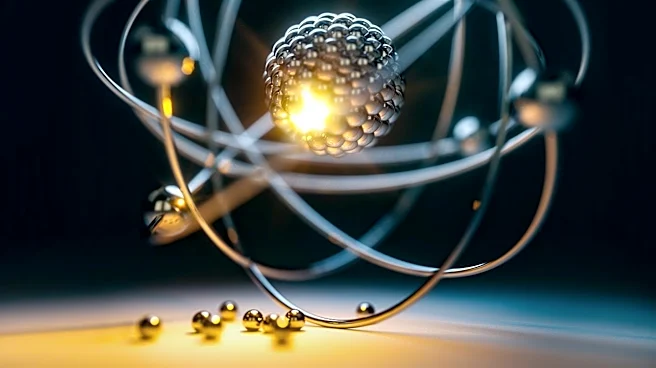
to extreme pressure exceeding 21 gigapascals, which is approximately 200,000 times normal atmospheric pressure. The process converted CuPc crystals into these elongated copper atomic chains, each encased within a carbon sheath. These structures, termed sheathed single-metal-atom chains (sSMACs), resemble a three-layered household power cord at an atomic scale. The core consists of a single-atom copper chain, surrounded by a conductive ring-like frame of carbon and nitrogen atoms, and an outer protective carbon sheath. The findings, published in Science, indicate that these wires exhibit strong anisotropy, meaning electricity flows much more easily along the wire than across it. This novel method bypasses the limitations of traditional liquid-solution growth techniques, which typically restrict the length of single-atom chains due to insolubility issues with the stabilizing ligands.
Why It's Important?
This development holds substantial importance for the future of electronics and materials science. As silicon-based chips approach their physical limits, the creation of ultrathin, highly conductive molecular wires could revolutionize how electronic components are interconnected. The ability to produce single-atom copper chains of unprecedented length opens new avenues for developing next-generation electronics, potentially leading to smaller, more efficient devices. The strong anisotropic electrical conductivity of these sSMACs suggests their utility in applications requiring precise control over current flow. Furthermore, these structures provide a unique platform for studying the fundamental physics of one-dimensional systems, offering insights into how matter behaves at the smallest scales. While the current method requires extreme pressures, which poses challenges for industrial scaling, the research establishes a proof of concept for solid-state reactions in creating advanced materials with tailored properties. The discovery that the surrounding carbon and nitrogen atoms, rather than the copper atoms themselves, conduct electricity in these specific sSMACs also challenges existing assumptions about conductivity in such materials.
What's Next?
The immediate next steps for researchers will likely involve exploring methods to scale down the extreme pressure requirements for synthesizing these ultralong single-atom copper chains, making the process more viable for industrial applications. Further investigation into the precise mechanisms of conductivity within the carbon and nitrogen framework is also anticipated, which could lead to the design of even more efficient molecular wires. Scientists may also explore the potential of other metal-ligand precursors and different pressure conditions to create similar or novel one-dimensional materials with unique electronic, magnetic, and catalytic properties. The stability of these sSMACs in harsh environments suggests their potential for integration into robust electronic systems, prompting research into their long-term performance and durability. Additionally, the findings could inspire new theoretical models and experimental techniques for understanding and manipulating matter at the atomic scale, pushing the boundaries of materials science and nanotechnology.
Beyond the Headlines
Beyond their immediate technological implications, the creation of these record-long single-atom copper chains touches upon deeper scientific and engineering challenges. The ability to precisely control and manipulate matter at the atomic level, as demonstrated by this research, represents a significant step towards realizing the full potential of nanotechnology. This breakthrough could lead to a paradigm shift in how we conceive and construct electronic components, moving from bulk materials to atomic-scale engineering. The unexpected finding that the carbon and nitrogen sheath, rather than the copper core, is responsible for electrical conduction highlights the complex and often counterintuitive properties that emerge at the nanoscale. This underscores the need for continued fundamental research to uncover new physical phenomena that could drive future innovations. The ethical considerations surrounding the widespread adoption of such advanced materials, including their environmental impact and accessibility, will also become increasingly relevant as these technologies mature. Ultimately, this research contributes to a broader scientific endeavor to understand and harness the fundamental building blocks of the universe for technological advancement.