
What's Happening?
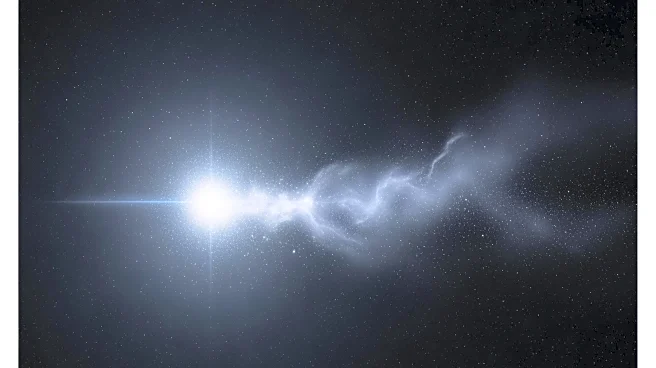
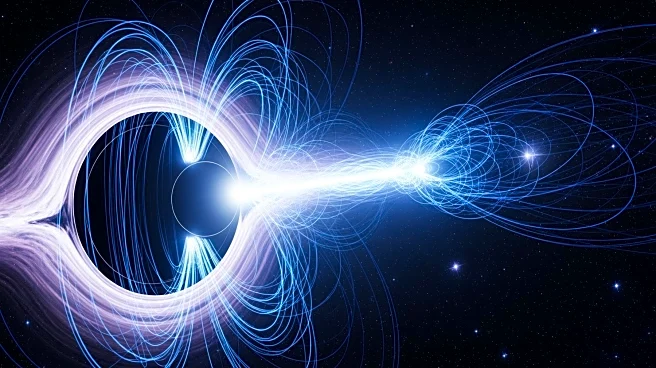
An international team of astronomers has observed a supermassive black hole ejecting matter at speeds reaching 20% of the speed of light. The event, observed near the black hole NGC 3783, was captured
using the XRISM space telescope. The ejection is believed to be caused by a process called magnetic reconnection, where sudden changes in magnetic fields release large amounts of energy. This phenomenon is similar to solar flares but on a much larger scale. The observation provides new insights into the behavior of black holes and their interactions with surrounding matter.
Why It's Important?
This discovery sheds light on the complex processes occurring near supermassive black holes, which are critical to understanding galaxy formation and evolution. The ability of black holes to eject matter at such high speeds influences the distribution of matter in galaxies and the universe. Understanding these processes helps scientists explore the role of black holes in shaping cosmic structures and the dynamics of galaxies. The findings also challenge existing theories about black hole behavior, prompting further research into the mechanisms driving these powerful events.
What's Next?
The research team plans to continue studying similar events to better understand the mechanisms behind high-speed ejections from black holes. Future observations will focus on identifying other instances of magnetic reconnection and exploring their impact on galaxy dynamics. The collaboration between international space agencies and research institutes will be crucial in advancing the study of black holes and their role in the universe. As more data becomes available, scientists hope to refine models of black hole behavior and their influence on cosmic evolution.