


What's Happening?
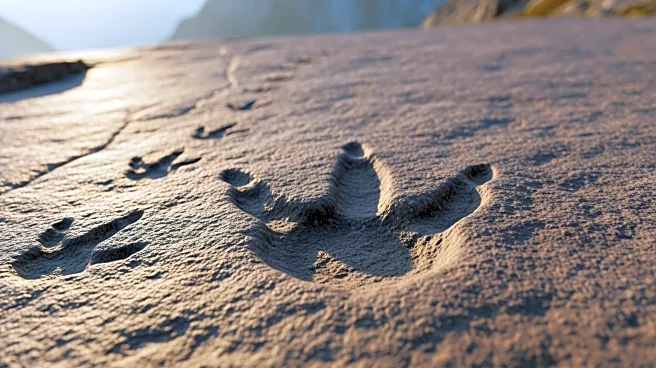
A wildlife photographer, Elio Della Ferrera, has discovered one of the largest known collections of dinosaur footprints in the Stelvio National Park, near the 2026 Milan Cortina Winter Olympic venue in Bormio, Italy. The footprints, dating back approximately
210 million years to the Triassic Period, were found on a vertical wall high in the park, which is located near the Swiss border. The site contains an estimated 20,000 footprints over a five-kilometer stretch. These tracks are believed to have been made by long-necked bipedal herbivores, similar to Plateosaurus, which were up to 10 meters long and weighed up to four tons. The discovery was made when Della Ferrera was photographing wildlife and noticed unusual markings on the rock face. The footprints suggest that the dinosaurs traveled in packs and sometimes stopped in circular formations, possibly for protection.
Why It's Important?
This discovery is significant as it provides valuable insights into the behavior and movement patterns of dinosaurs during the Triassic Period. The sheer number of footprints and their well-preserved state offer a rare opportunity for paleontologists to study these ancient creatures in detail. The location of the find, near a major upcoming international event, the 2026 Winter Olympics, adds to its prominence. The discovery has been hailed as a 'gift for the Olympics' by Lombardy's regional governor, Attilio Fontana, highlighting its potential to attract scientific interest and tourism. However, the site's remote location poses challenges for public access, especially during winter.
What's Next?
While the site is currently too remote for public access, there may be future plans to make it accessible to visitors, potentially boosting tourism in the region. The discovery is likely to attract further scientific research, with paleontologists eager to study the footprints in more detail. The findings could lead to new insights into the ecology and environment of the Triassic Period, as well as the evolutionary history of dinosaurs. Additionally, the proximity to the Olympic venue may lead to increased media attention and interest from the international community.