


What's Happening?
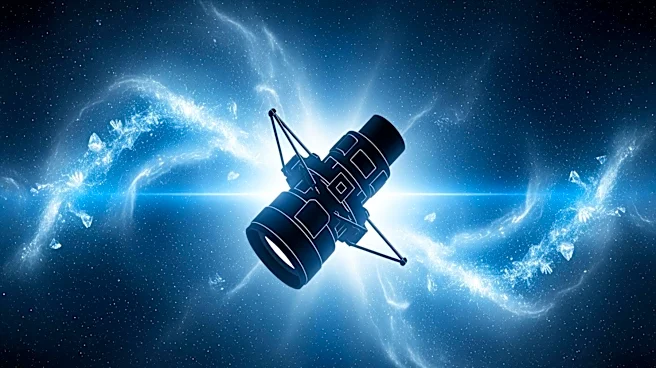
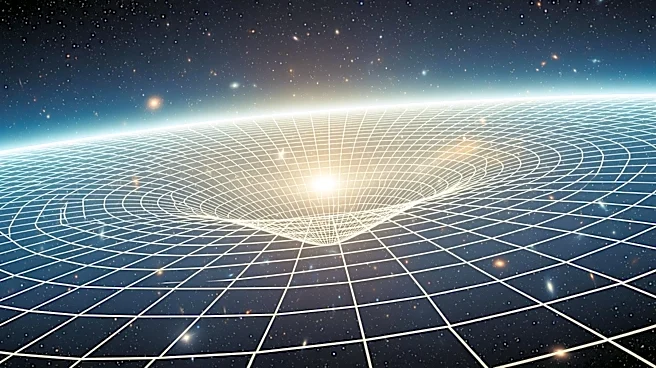
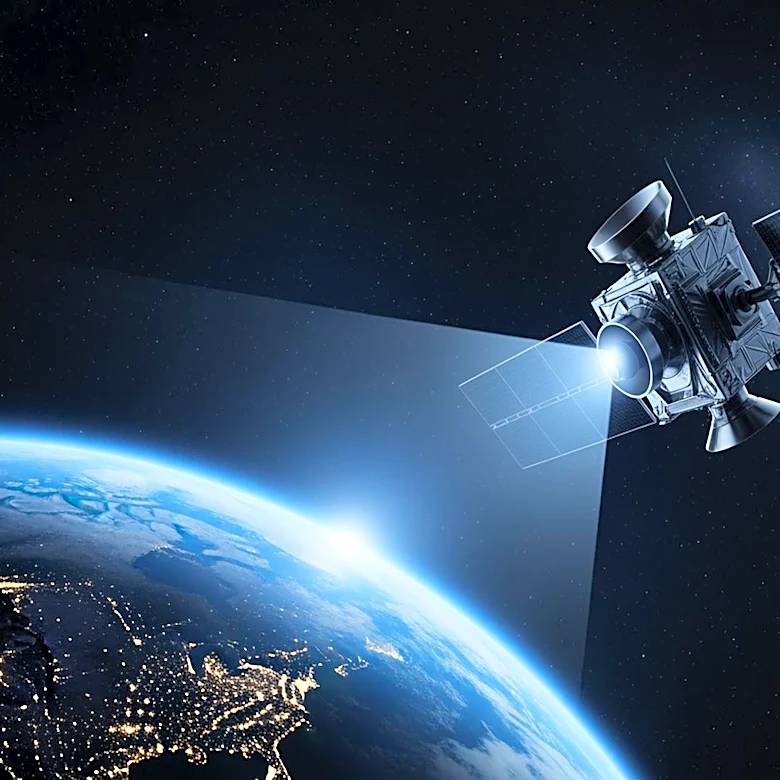
Recent observations from the Atacama Cosmology Telescope (ACT) have confirmed that gravity behaves according to Newton's and Einstein's laws even at cosmic scales. The study, led by Patricio A. Gallardo from the University of Pennsylvania, tested gravity across
galaxy clusters separated by hundreds of millions of light-years. The findings, published in Physical Review Letters, show that gravity's strength weakens with distance as predicted by the inverse square law. This confirmation supports the standard model of cosmology and challenges theories like Modified Newtonian Dynamics (MOND) that propose changes to gravity's behavior.
Why It's Important?
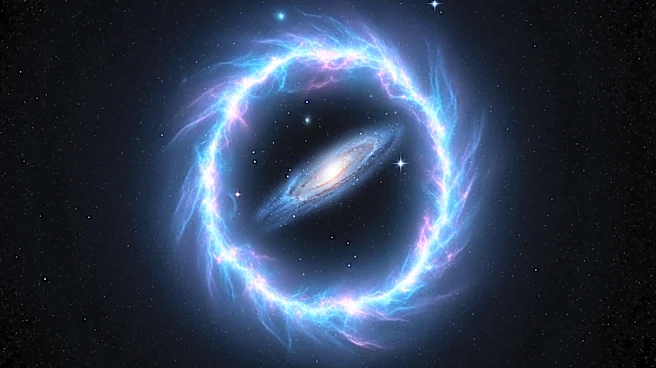
This study reinforces the fundamental principles of gravity as described by Newton and Einstein, providing a crucial validation of the standard model of cosmology. By confirming that gravity behaves as expected over vast distances, the research strengthens the case for the existence of dark matter, which is believed to account for the missing mass in the universe. Understanding gravity's behavior at cosmic scales is essential for explaining the motion of galaxies and the structure of the universe. The findings also close the door on alternative theories that suggest modifications to gravity's laws.
What's Next?
Future research will continue to explore the nature of dark matter and its role in the universe's structure. Scientists will use larger galaxy surveys and observations of the cosmic microwave background to test gravity with even greater precision. These efforts aim to uncover the true nature of dark matter and further validate the standard model of cosmology. As researchers delve deeper into the mysteries of the universe, they hope to resolve longstanding questions about the forces shaping cosmic evolution.