



What's Happening?
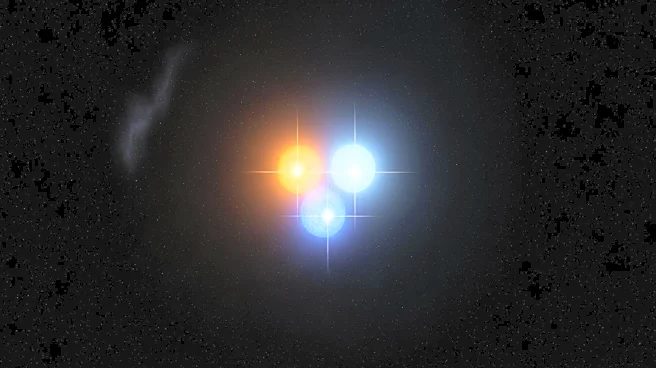
The James Webb Space Telescope (JWST) has captured stunning images of the triple star system Apep, revealing four coiled dust shells swirling around it. These patterns, formed by two massive Wolf-Rayet stars and shaped by a third companion, glow in mid-infrared
light. This first-of-its-kind capture provides a rare opportunity to study the violent winds of dying stars and understand how heavy elements are distributed in the universe. The images highlight the JWST's capability to observe celestial phenomena with unprecedented detail.
Why It's Important?
The JWST's observations of Apep offer valuable insights into the life cycles of massive stars and the processes that contribute to the formation of new worlds. By studying the distribution of heavy elements, scientists can better understand the conditions necessary for planet formation and the potential for life elsewhere in the universe. The telescope's ability to capture such detailed images also demonstrates its critical role in advancing our knowledge of astrophysics and the universe's evolution.