
What's Happening?
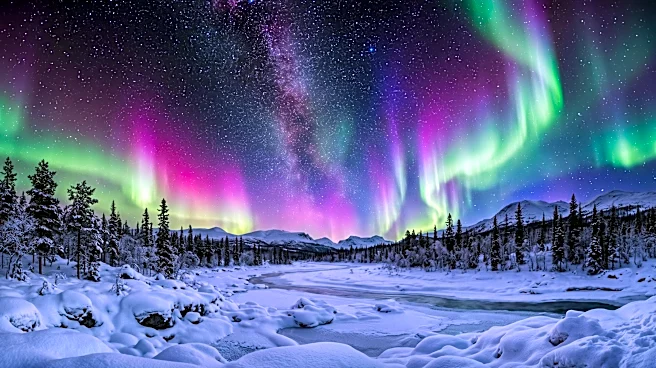
The 'Aurora Forecast: Live Alerts' app provides users with real-time data and predictive tools to enhance their chances of viewing the Northern Lights. The application integrates various data points, including
real-time KP index alerts, an interactive 3D aurora globe, NOAA space weather data, 72-hour predictions, and a 27-day trip planning calendar. It aims to offer precise visibility forecasts by combining space weather, cloud cover, moon phase, solar wind statistics, and local darkness information. Users can receive instant push notifications when geomagnetic activity increases, with customizable thresholds based on their latitude. The app also features a 3D globe aurora map displaying real-time auroral oval activity and intensity, along with NOAA OVATION probability heatmap overlays to help locate active auroras. Additionally, it provides live satellite feeds for solar wind speed, particle density, and magnetic vectors, as well as high-resolution NASA SDO solar imagery.
Why It's Important?
This technology is important for enthusiasts and tourists planning to witness the Northern Lights, particularly in regions like Alaska, Canada, and parts of the northern U.S. By providing precise, real-time data and long-range forecasts, the app significantly reduces the uncertainty associated with aurora hunting. This can lead to more efficient travel planning and a higher success rate for viewing the natural phenomenon, boosting local tourism economies in aurora-prone areas. The integration of NOAA and NASA data ensures scientific accuracy, making the information reliable for users. For individuals in the U.S. who might experience rare mid-latitude auroras, the app's alert system can notify them of potential viewing opportunities from their backyards, democratizing access to this natural spectacle beyond traditional viewing destinations. The detailed forecasts also allow for better resource allocation for tour operators and local businesses catering to aurora tourism.
What's Next?
The continuous development and refinement of such aurora forecasting applications are expected to further integrate more sophisticated predictive models and user-friendly features. Future updates may include enhanced AI-driven predictions, more localized weather overlays, and community-driven sighting reports to improve accuracy. The app's 27-day solar rotation forecast calendar suggests a trend towards longer-term planning tools, which could influence travel and tourism industries by enabling more confident booking of trips to aurora destinations. As space weather monitoring technology advances, these apps will likely incorporate even more granular data, potentially offering even earlier and more precise warnings of geomagnetic storms and auroral displays. This could lead to a broader public engagement with space weather phenomena and an increased appreciation for the science behind the Northern Lights.
Beyond the Headlines
The 'Aurora Forecast: Live Alerts' app represents a broader trend in leveraging advanced data analytics and mobile technology to connect people with natural phenomena. Beyond its immediate utility for aurora viewing, it highlights the increasing accessibility of complex scientific data to the general public. By simplifying space weather metrics into understandable terms and actionable forecasts, the app fosters a greater public understanding of solar activity and its impact on Earth. This kind of technological innovation can inspire interest in STEM fields, particularly among younger generations, by making scientific concepts tangible and exciting. Furthermore, the app's ability to predict and alert users to rare mid-latitude auroras could contribute to a shared cultural experience across wider geographical areas, fostering a sense of wonder and connection to the natural world that transcends geographical boundaries.