
What's Happening?
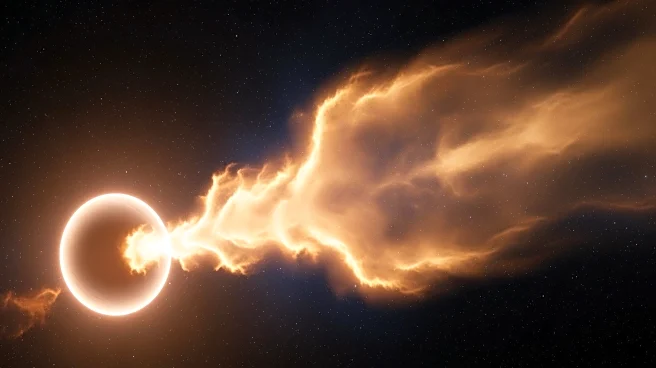
The James Webb Space Telescope (JWST) has observed a distant exoplanet, WASP-107b, shedding its atmosphere, specifically a giant cloud of helium gas. This phenomenon, known as atmospheric escape, was captured
as the helium cloud extended nearly 10 times the planet's radius. The exoplanet, categorized as a 'super-puff' due to its low density, is located much closer to its star than Mercury is to the Sun. The JWST's observations also detected water vapor in the atmosphere but found no evidence of methane. The presence of another planet, WASP-107c, may have influenced WASP-107b's migration closer to its star, contributing to the atmospheric loss.
Why It's Important?
This discovery provides significant insights into the evolution of planetary atmospheres, particularly for gas giants. Understanding the atmospheric escape of WASP-107b helps scientists learn about the processes that strip planets of their gaseous envelopes, a phenomenon that can also occur on Earth-like planets. The findings support the theory that giant planets form far from their host stars and migrate inward, where they lose their atmospheres due to intense heat. This research could enhance our understanding of atmospheric dynamics and the potential habitability of exoplanets.
What's Next?
Further observations by the JWST and other telescopes could provide more data on the atmospheric composition and dynamics of WASP-107b and similar exoplanets. These studies may reveal more about the role of nearby planets in influencing atmospheric loss and migration patterns. Continued research could also improve models of planetary formation and evolution, offering a broader understanding of the diversity of planetary systems.
Beyond the Headlines
The study of WASP-107b's atmospheric escape could have implications for understanding the long-term stability of planetary atmospheres, including those of Earth-like planets. The research highlights the importance of advanced telescopes like the JWST in uncovering the complexities of distant worlds, potentially informing future missions aimed at detecting life beyond our solar system.