
What's Happening?
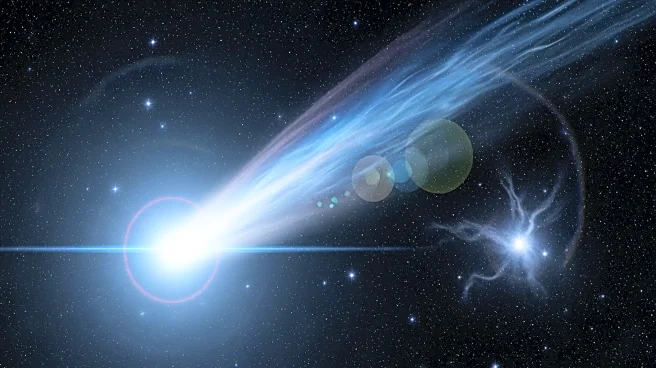
The interstellar comet 3I/ATLAS, only the third such object confirmed to have entered our solar system from another galaxy, has been the subject of intense observation by various space agencies. Recent
images released by the European Space Agency and NASA's Hubble Space Telescope have added to the growing collection of data on this rare celestial visitor. The comet, which reached its closest point to the sun at the end of October, is set to pass by Earth on December 19, maintaining a safe distance of approximately 170 million miles. Observations have revealed that the comet's coma, a cloud of gas and dust surrounding its nucleus, contains ice water and carbon dioxide, similar to comets formed within our solar system.
Why It's Important?
The study of interstellar objects like 3I/ATLAS provides valuable insights into the composition and behavior of celestial bodies from outside our solar system. Understanding these objects can enhance our knowledge of the universe's formation and the processes that govern it. The data collected from 3I/ATLAS could potentially inform future space exploration missions and contribute to the development of new technologies for observing and analyzing distant cosmic phenomena. Additionally, the comet's passage offers a unique opportunity for collaboration among international space agencies, fostering advancements in astronomical research and technology.