





What's Happening?
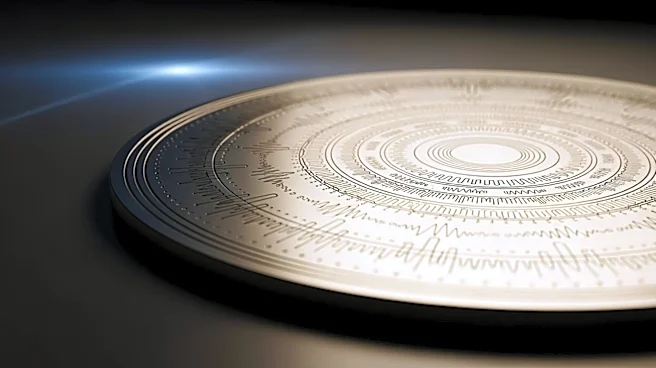
NASA's Voyager spacecraft, launched in 1977, each carry a phonograph record known as the Voyager Golden Record. These records contain sounds and images representing Earth, curated by a committee led by Carl Sagan. A unique feature of these records is
the inclusion of a small sample of uranium-238 on their covers. This uranium serves as a timekeeping device, allowing any potential finder to measure the decay of the uranium to determine how long the record has been in space. The uranium-238 has a half-life of about 4.5 billion years, making it an ideal choice for long-term time measurement. Additionally, the record covers include a pulsar map, which provides another method for dating the records by comparing the current pulsar rotation periods with those recorded on the cover.
Why It's Important?
The inclusion of uranium-238 and a pulsar map on the Voyager Golden Records highlights NASA's foresight in ensuring that these messages from Earth can be accurately dated by any potential extraterrestrial finders. This dual-method approach to timekeeping underscores the importance of redundancy in scientific endeavors, especially when dealing with the vast timescales and distances of space. The Voyager mission itself represents a significant achievement in human exploration and communication, as these records are designed to last for billions of years, potentially outlasting humanity itself. The ability to date these records accurately could provide invaluable context to any future civilizations or entities that might encounter them, offering a glimpse into Earth's history and technological capabilities at the time of launch.
What's Next?
While the Voyager spacecraft are not aimed at any specific recipient and are unlikely to be found for tens of thousands of years, the design of the Golden Records ensures that they remain a testament to human ingenuity and curiosity. The records are expected to continue drifting through interstellar space, with their messages intact, for potentially billions of years. The ongoing study of the Voyager mission and its components, like the Golden Record, continues to inspire new generations of scientists and engineers to think creatively about long-term space exploration and communication.
Beyond the Headlines
The Voyager Golden Record's design reflects a deep understanding of both the challenges and possibilities of interstellar communication. The use of uranium-238 as a timekeeping device is a testament to the careful consideration of material science and decay rates, ensuring that the message remains dateable over astronomical timescales. This approach also raises philosophical questions about the nature of communication and legacy, as the records are not expected to be found, yet they carry a message of hope and curiosity into the cosmos. The Voyager mission, through its Golden Records, serves as a cultural artifact, representing humanity's desire to reach out and connect with the unknown.