






What's Happening?
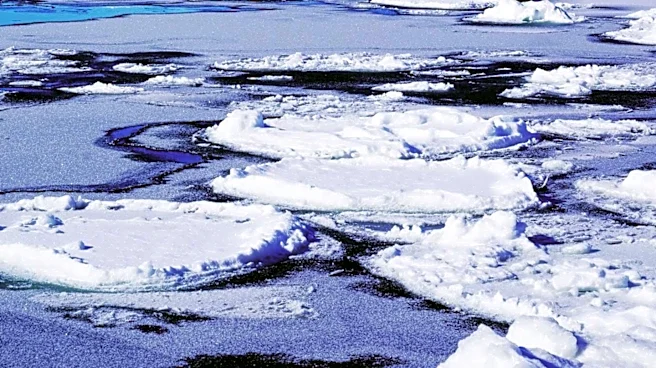
New research indicates that the Arctic could lose approximately one million square kilometers more winter sea ice than previously predicted. This revised estimate is based on evidence from a warmer Arctic period 6,000 years ago, which has been used to
refine modern climate models. The findings, published in Nature Geoscience, suggest that current climate models collectively overestimated the amount of winter sea ice. Scientists from the University of Cambridge and Mexico's Centro de Investigación en Matematicas (CIMAT) analyzed a chemical marker (IP25) from algae in sea ice found in sediment cores from the mid-Holocene. By comparing these ancient climate records with simulations from 27 climate models, they assigned greater weight to models that more accurately reflected historical conditions. This methodology reduced the uncertainty in some projections by up to 85%, leading to a clearer picture of future Arctic ice loss. The study emphasizes that the physical principles governing sea ice melt remain consistent regardless of whether warming is natural or human-induced.
Why It's Important?
The accelerated loss of Arctic winter sea ice has significant implications for global weather patterns, including those in the United States. Winter sea ice plays a crucial role in regulating heat and moisture exchange between the ocean and the atmosphere. A decline in this ice cover has been linked to colder winters and increased snowfall in North America, as well as the United Kingdom and northern Europe. More accurate predictions of sea ice loss are vital for understanding and preparing for these shifts in weather. Furthermore, the study suggests that current climate models might also be underestimating future snowfall in southeastern Greenland and rainfall in the Mediterranean region. Increased snowfall in Greenland could impact the stability of its ice sheet, while higher rainfall in the Mediterranean could lead to greater flooding risks. These potential changes highlight the far-reaching consequences of a warming Arctic on various regions and their climate-dependent sectors.
What's Next?
The refined climate models provide a more reliable foundation for researchers to investigate the broader risks associated with Arctic warming. Future efforts will likely focus on further integrating these improved predictions into regional climate assessments to better understand specific impacts on weather, agriculture, and infrastructure. Policymakers and communities in affected areas, including parts of North America, will need to consider these updated projections when developing strategies for climate adaptation and mitigation. The research also underscores the ongoing need for sustained scientific funding and collaboration to enhance climate modeling and monitoring capabilities. Continued observation of Arctic sea ice and its influence on global atmospheric circulation will be critical for validating and further refining these predictions, enabling more informed decision-making in the face of a changing climate.
Beyond the Headlines
This research highlights the critical role of paleoclimate data in improving the accuracy of future climate predictions. By looking to the Earth's past, scientists can calibrate and validate complex climate models, reducing uncertainties that have historically hampered long-term forecasts. The methodology employed, using Bayesian weighting to prioritize more accurate models, represents a significant advancement in climate science. It demonstrates that even though the causes of past warming (orbital changes) differ from current warming (human activity), the fundamental physical responses of the Earth system remain consistent. This reinforces the scientific consensus on climate change and its potential impacts, urging a re-evaluation of current climate projections and adaptation strategies. The interconnectedness of global climate systems means that changes in a seemingly remote region like the Arctic can have profound and widespread effects, necessitating a holistic approach to climate research and policy.