
What's Happening?
Russia has secured a patent for a space station design that incorporates artificial gravity, a significant development as the International Space Station (ISS) approaches its decommissioning in 2030. The
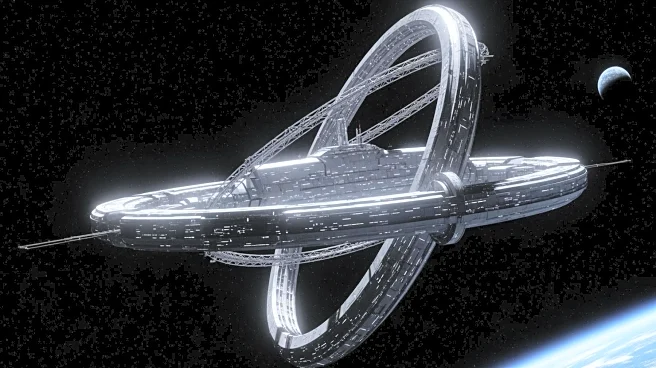
Russian state rocket company, Energia, has proposed a rotating space structure that mimics a carnival centrifuge to generate artificial gravity. This design aims to address the challenges of prolonged human exposure to zero gravity, which can lead to muscle atrophy and bone density loss. The proposed station would simulate 0.5g, or half of Earth's gravity, by spinning at five revolutions per minute. The design features a modular structure with habitable modules extending outward like spokes on a wheel. However, the construction of such a station presents significant engineering challenges, including the need for multiple rocket launches and complex in-orbit assembly.
Why It's Important?
The development of a space station with artificial gravity is crucial for the future of deep-space exploration. It offers a potential solution to the physical challenges faced by astronauts during long-term missions, such as those to Mars or extended stays in orbit. By providing a more Earth-like environment, the station could reduce the need for extensive daily exercise regimens currently required on the ISS. This innovation positions Russia as a key player in the new space race, as other entities, including American companies and NASA, explore similar concepts. The patent signals Russia's intent to pursue independent space endeavors, moving away from international collaborations like the ISS.
What's Next?
While the patent marks a significant step, Russia has not yet committed resources or a timeline to the project. The country plans to exit the ISS by 2028 and may repurpose its existing ISS modules for its Russian Orbital Space Station (ROSS). The development of artificial gravity stations could lead to new partnerships or competition in the space industry, as other nations and private companies pursue similar technologies. The success of such projects could redefine human space travel and habitation, potentially leading to permanent human presence in space.