






What's Happening?
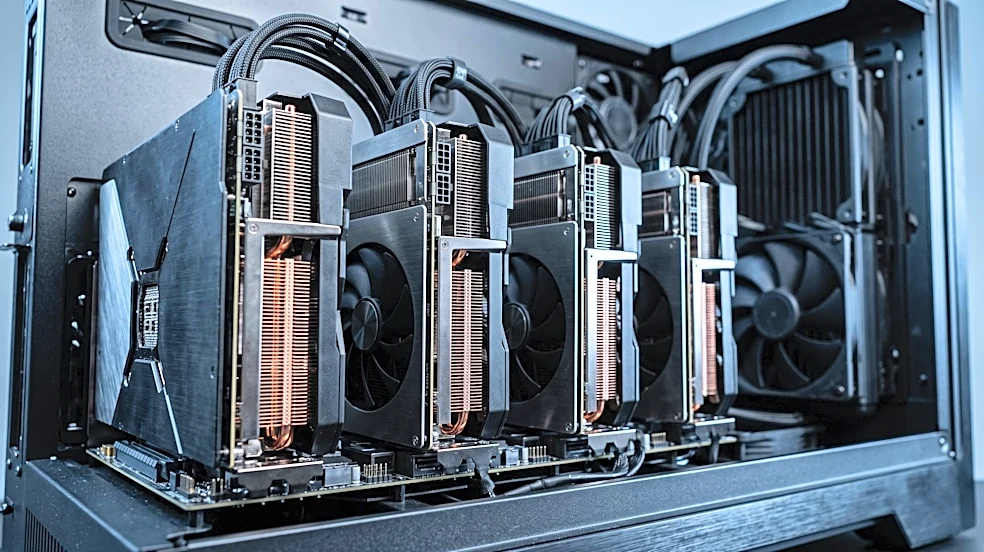
A research team working with Apex Fusion has successfully replicated the central experiment of MIT's SwarmWorld study on consumer-grade hardware, specifically four RTX 3090 gaming GPUs. The original MIT study demonstrated that a society of AI agents,
without explicit instructions, could invent, build, and maintain technology more effectively than individual agents. The replication, led by Časlav Nedeljković of HAL8, used MIT's original code and commands but swapped the frontier model for a compressed open-weight model (Qwen3.8-27B) and ran it on consumer GPUs. The results largely matched MIT's findings, with nine out of twelve paired effects aligning in direction, including gains in portfolio resilience and self-organization. Notably, the collective performance of the AI agent society was robust, with the weaker Qwen model achieving all 16 research milestones in a society setting, compared to only 6 when working alone.
Why It's Important?
The successful replication of MIT's SwarmWorld results on consumer GPUs is highly significant. It demonstrates that the emergent collective intelligence observed in AI agent societies is not solely dependent on cutting-edge, resource-intensive frontier models or specialized hardware. This accessibility means that the principles of agent self-organization and collaborative problem-solving could be explored and implemented more widely, potentially democratizing AI research and development. The finding that a weaker model performs significantly better in a societal context underscores the power of collective intelligence and distributed problem-solving in AI. This has implications for how AI systems are designed and deployed, suggesting that networked agents could achieve complex goals even with individually less powerful models. Furthermore, the study's implications for AI safety, as highlighted by MIT's Markus Buehler, are reinforced: if agents can coordinate through environmental changes, monitoring their internal communications alone may be insufficient for oversight.
What's Next?
Further research will involve rerunning the experiment with larger populations of AI agents, as explored in MIT's original study, to confirm the scalability of these findings. Apex Fusion, which is building infrastructure for AI agents, is also opening its Vector marketplace to frontier labs, research institutions, and universities, aiming to facilitate the development of multi-organization agent networks. The foundation is also joining the Agentic AI Foundation to contribute to standards like the Model Context Protocol and Agent2Agent. The ability to run these complex simulations on consumer hardware suggests that more individuals and smaller organizations could contribute to the understanding and development of AI agent societies, potentially accelerating innovation in this field. The ongoing work will also explore the use of blockchain technology for recording and settling agent interactions, addressing questions of attribution and trust in collaborative AI environments.
Beyond the Headlines
The replication of SwarmWorld on consumer GPUs suggests a future where sophisticated AI agent societies could operate outside of centralized, high-resource environments. This decentralization could lead to a proliferation of AI applications and services, potentially impacting various sectors from scientific research to complex logistical operations. The concept of AI agents self-organizing and developing technologies without explicit instructions raises profound questions about autonomy, creativity, and the nature of intelligence itself. The implications for AI safety are particularly salient; if collective AI systems can achieve complex goals with emergent behaviors, new paradigms for monitoring and control will be necessary. This research pushes the boundaries of our understanding of artificial intelligence, moving beyond individual models to explore the dynamics and capabilities of interconnected AI entities, potentially leading to new forms of human-AI collaboration and governance.