
What's Happening?
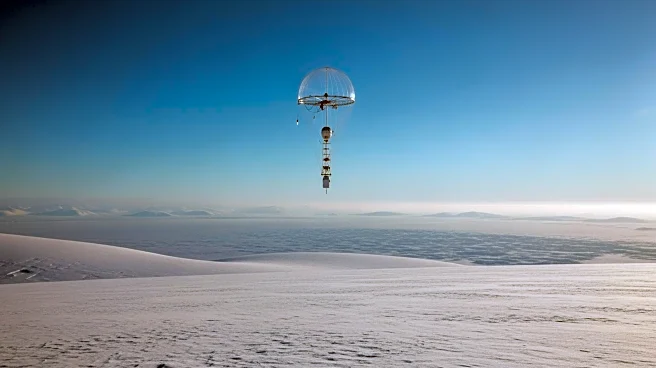
The Payload for Ultrahigh Energy Observations (PUEO) mission, led by the University of Chicago, successfully completed a 23-day journey aboard a NASA balloon over Antarctica. Launched on December 20, the mission aimed
to detect high-energy neutrinos, elusive particles that could provide insights into extreme cosmic events like black holes and neutron star collisions. The balloon, carrying an advanced instrument designed to capture faint radio signals from neutrino interactions in the Antarctic ice, landed near the South Pole on January 12. The mission is part of NASA's Astrophysics Pioneers program, and PUEO is the first to launch under this initiative. The data collected, stored in a 'black box,' will be analyzed to identify these rare particles, potentially offering a new understanding of the universe's most energetic phenomena.
Why It's Important?
The PUEO mission represents a significant advancement in astrophysics, as detecting high-energy neutrinos could unlock new knowledge about the universe's most violent and energetic events. These particles, more energetic than those produced in the Large Hadron Collider, could reveal processes occurring in black holes or during neutron star collisions. The mission's success could lead to breakthroughs in understanding cosmic phenomena and the fundamental forces of nature. Additionally, the technological advancements in PUEO's design, such as its enhanced sensitivity and real-time signal processing, set a new standard for future astrophysical research. The findings could have implications for theoretical physics and cosmology, potentially influencing future research directions and funding priorities.
What's Next?
Following the retrieval of PUEO's data, scientists at the University of Chicago will begin the extensive process of analyzing the 50 to 60 terabytes of information collected. This analysis is expected to take several months, with initial results anticipated within a year. The findings could confirm the presence of high-energy neutrinos, providing new insights into cosmic events. The success of PUEO may also influence the design and implementation of future missions under NASA's Astrophysics Pioneers program, encouraging further exploration of high-energy astrophysics. The scientific community will be closely monitoring the outcomes, which could lead to new collaborations and research initiatives aimed at exploring the universe's most extreme environments.