







What's Happening?
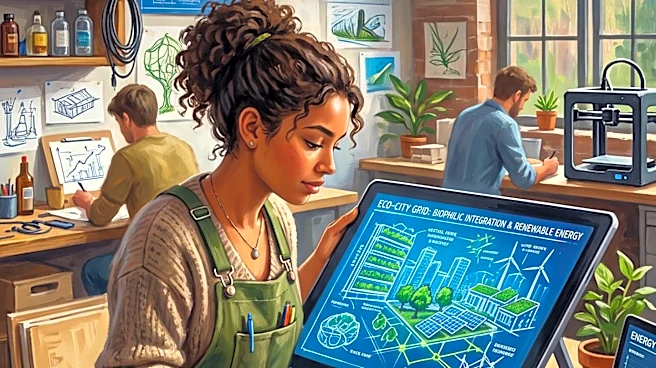
A new study from Concordia University proposes an integrated model for urban neighborhoods to enhance local resource self-sufficiency and reduce carbon footprints. Published in the journal Energies, the model combines urban agriculture, solar power, rainwater
harvesting, and local food-sharing networks. Researchers used Montreal's Pointe-St-Charles neighborhood as a case study, transforming underused rooftops, vacant lots, and parking areas into hubs for food, energy, and water resources. The model suggests assigning rooftops to greenhouses, green roofs, or solar panels based on the building, and utilizing vacant lots for crop cultivation. Solar-panel canopies over parking areas could generate electricity, and harvested rainwater could be used for irrigation. This approach aims to optimize the interaction between these systems rather than treating them in isolation.
Why It's Important?
This study offers a significant framework for U.S. cities grappling with resource management, climate change, and urban sustainability. By integrating food, energy, and water systems, the model demonstrates a pathway to increased local self-sufficiency, which can reduce reliance on external supply chains and enhance urban resilience against disruptions. The potential to cut food transportation emissions by 96% and grid electricity emissions by 27.5% (excluding greenhouse electricity demand) highlights substantial environmental benefits. For U.S. urban planners and policymakers, this research provides a blueprint for retrofitting existing neighborhoods to reduce energy demand, increase renewable energy production, and improve water resource management, fostering more sustainable and livable cities.
What's Next?
While the framework is designed for adaptability, real-world implementation in U.S. neighborhoods would require local assessment, testing, and permits. The study suggests that this transformation could be implemented in stages, depending on local priorities. This phased approach allows for gradual integration of sustainable practices into existing urban fabrics, avoiding the substantial impacts of demolition and rebuilding. Future steps would involve pilot projects in U.S. cities to test the model's effectiveness and scalability, as well as policy development to incentivize such integrated urban planning. The concept aligns with the growing interest in '15-minute cities,' where residents can meet daily needs close to home, promoting community connection and reduced carbon footprints.
Beyond the Headlines
The deeper implications of this study extend to the philosophical shift in urban development. It advocates for a 'whole-neighborhood approach' that views cities not just as collections of buildings but as interconnected ecosystems. This perspective challenges traditional siloed approaches to infrastructure and resource management, promoting a more holistic and integrated design. The model also emphasizes preserving a sense of place and neighborhood continuity, contrasting with large-scale urban renewal projects that often displace communities. By focusing on local resource production and reduced emissions, the study touches upon environmental justice, aiming to create healthier and more equitable urban environments. It suggests a future where urban areas are not just consumers but also producers of essential resources, fostering greater resilience and community well-being.