



What's Happening?
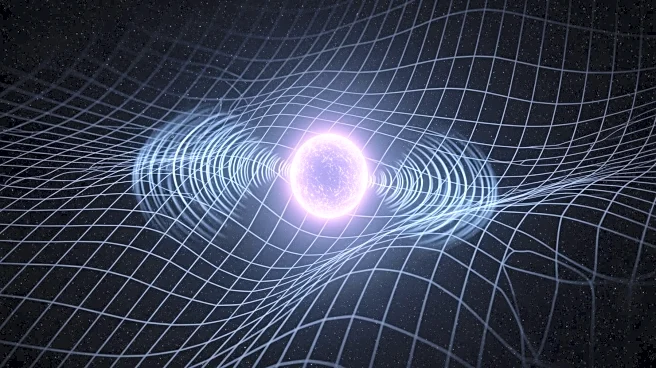
Researchers have developed a theoretical model to detect exotic matter, specifically quark-gluon plasma, inside neutron stars. Neutron stars are incredibly dense, with a mass several times that of the Sun compressed into a small sphere. The extreme pressure
inside these stars may break apart neutrons, forming a quark-gluon plasma, a state of matter that last existed just after the Big Bang. The researchers plan to analyze gravitational waves emitted by binary neutron star systems as they merge. These waves carry a 'signature' of the stars' internal structure, which can reveal the presence of quark-gluon plasma. The study, led by Nicolás Yunes from the University of Illinois and Abhishek Hegade from Princeton University, was published in Physical Review Letters.
Why It's Important?
Understanding the interior of neutron stars could provide significant insights into the fundamental nature of matter under extreme conditions. Detecting a quark-gluon plasma within neutron stars would offer a glimpse into the universe's state shortly after the Big Bang. This research is crucial for testing theories of gravity and the behavior of matter at extreme densities. The ability to 'see' inside neutron stars using gravitational waves could revolutionize our understanding of these celestial objects and the fundamental forces at play in the universe.
What's Next?
The theoretical model proposed by the researchers needs validation through observational data from next-generation gravitational wave detectors. These detectors are expected to have the sensitivity required to detect the imprint of neutron star oscillations on gravitational waves. Successful detection of quark-gluon plasma would confirm the model and provide new insights into the physics of neutron stars. The research community anticipates further developments in gravitational wave astronomy, which could lead to more discoveries about the universe's most extreme environments.