



What's Happening?
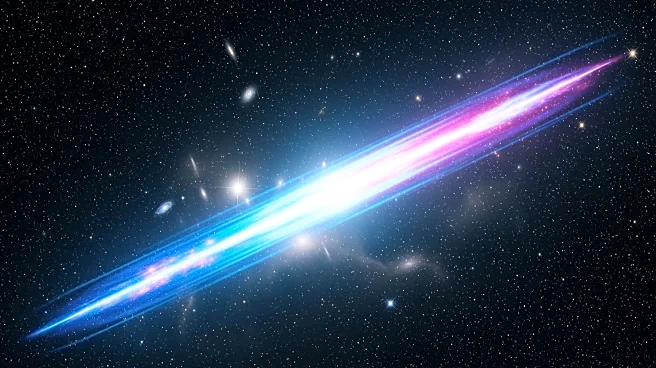
NASA's Fermi Gamma-ray Space Telescope has recorded the longest-duration gamma-ray burst (GRB) ever observed, named GRB 250702B. This event, detected on July 2, 2025, lasted over seven hours and originated from a massive galaxy 8 billion light-years away
in the constellation Scutum. The burst is believed to have launched a narrow jet of material traveling at 99% the speed of light towards the solar system. The event was challenging to analyze due to the thick dust in its host galaxy, which blocked visible light, leaving only infrared and high-energy X-ray wavelengths detectable. Researchers utilized various telescopes, including the Gemini telescopes, the Very Large Telescope, the Keck Observatory, and the Hubble Space Telescope, to study the burst's afterglow and origin.
Why It's Important?
The discovery of GRB 250702B is significant as it challenges existing models of gamma-ray bursts, which are the most energetic explosions in the universe since the Big Bang. Understanding such events can provide insights into the life cycles of massive stars and the dynamics of black holes. The event's unusual duration and characteristics suggest it may have been caused by rare cosmic phenomena, such as a massive star's death, a star being torn apart by a black hole, or a merger involving a helium star and a black hole. This discovery could lead to new theories about the universe's most powerful explosions and help astronomers identify similar events in the future.
What's Next?
Future research will focus on determining the exact cause of GRB 250702B. Astronomers will continue to monitor similar events to see if they match the properties of this burst or represent different phenomena. The event will serve as a benchmark for future studies, potentially leading to new classifications of gamma-ray bursts. The James Webb Space Telescope's observations of the host galaxy may provide further insights into the conditions that led to this extraordinary explosion.