
What's Happening?
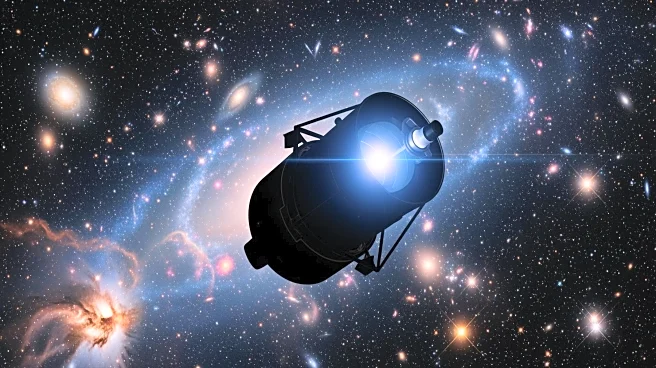
The James Webb Space Telescope (JWST), launched on December 25, 2021, has significantly advanced our understanding of the universe. Positioned at a Lagrange point 930,000 miles from Earth, the telescope
has provided unprecedented insights into the 'cosmic dawn,' a period shortly after the Big Bang. JWST's infrared capabilities allow it to observe ancient light that has been red-shifted over time, revealing early star formations and potentially life-sustaining atmospheres on distant exoplanets. Despite initial budget overruns and delays, the telescope's contributions to cosmology have been profound, challenging existing models and expanding our knowledge of the universe's expansion rates and early galaxies.
Why It's Important?
JWST's ability to observe the universe's earliest epochs offers critical data that could reshape our understanding of cosmological phenomena. Its findings have implications for theories about the universe's expansion and the formation of galaxies and black holes. The telescope's discoveries could lead to new scientific models and a deeper comprehension of the universe's origins. Additionally, JWST's success underscores the importance of international collaboration in scientific endeavors, as it was developed with contributions from NASA, the European Space Agency, and the Canadian Space Agency.
What's Next?
As JWST continues to operate, it is expected to provide further insights into the universe's early history and the potential for life beyond Earth. The data it collects will be crucial for astronomers and physicists seeking to refine existing theories and develop new ones. Ongoing analysis of JWST's findings will likely lead to more discoveries about the universe's structure and the processes that govern it. The telescope's continued success will also influence future space missions and the development of advanced observational technologies.