







What's Happening?
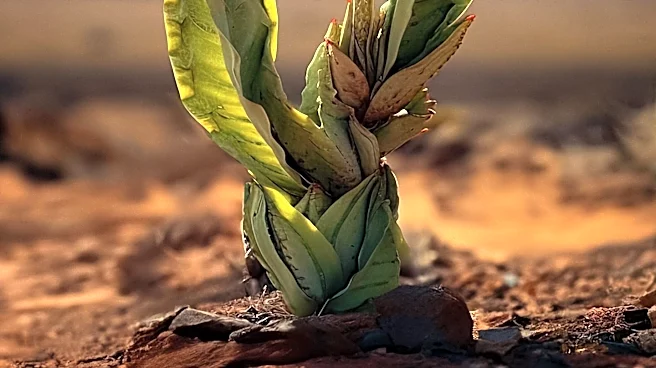
A rare plant, the threecorner milkvetch, is unexpectedly flourishing within the Gemini Solar Project in Nevada's Mojave Desert. Pre-construction surveys identified only 12 individuals of this species, which is under consideration for the U.S. Endangered
Species Act. However, post-construction surveys in 2024 revealed 93 plants inside the solar farm, an eightfold increase. Researchers led by Tiffany Pereira of Nevada’s Desert Research Institute found that milkvetch plants within the array produced eight times more flowers and ten times more fruit than those in undisturbed areas. This enhanced growth is attributed to the solar panels altering the microclimate by providing shade, reducing wind speeds, and concentrating rainwater, which helps the soil retain moisture longer. The project's developers also adopted 'ecovoltaics' practices, minimizing ground disturbance during construction, which preserved the existing seed bank.
Why It's Important?
This discovery challenges conventional assumptions about the ecological impact of large-scale solar developments, suggesting that with careful planning, such projects can potentially create beneficial microhabitats for native species. For the U.S. renewable energy industry, this finding could influence future site selection and construction practices, promoting more ecologically sensitive development models. It highlights the potential for 'ecovoltaics' to become a standard, integrating biodiversity conservation with renewable energy production. This could mitigate environmental opposition to solar farms and streamline permitting processes, especially in sensitive ecosystems. The success of the milkvetch demonstrates that industrial infrastructure, when thoughtfully designed, might offer unexpected refuges for vulnerable species, contributing to broader conservation goals while advancing clean energy initiatives.
What's Next?
Further research will be needed to determine if these positive ecological outcomes are replicable across different species, solar farm designs, and desert environments. The study's findings may prompt solar developers to adopt more 'ecovoltaics' approaches, such as minimizing ground grading and optimizing panel height and spacing to create favorable microclimates. Policy makers and environmental agencies might consider incorporating these findings into guidelines for solar farm development, potentially leading to new regulations that encourage biodiversity-friendly construction. This could foster a new paradigm where solar energy projects are viewed not just as energy producers but also as potential contributors to ecological restoration and conservation efforts, particularly for species adapted to specific desert conditions.
Beyond the Headlines
The success of the threecorner milkvetch at the Gemini Solar Farm raises profound questions about the future of conservation in an era of rapid industrial expansion. It suggests a paradigm shift where human infrastructure, often seen as detrimental to nature, could be designed to foster biodiversity. This development could lead to a re-evaluation of land use policies, encouraging a more integrated approach to development and conservation. Ethically, it challenges the anthropocentric view that nature must be preserved in pristine, untouched states, suggesting that managed, human-altered landscapes can also support ecological health. Legally, it might influence environmental impact assessments for large-scale projects, pushing for more nuanced evaluations that consider potential ecological benefits alongside traditional mitigation strategies. Culturally, it offers a hopeful narrative, demonstrating that technological advancement and ecological well-being are not mutually exclusive.