






What's Happening?
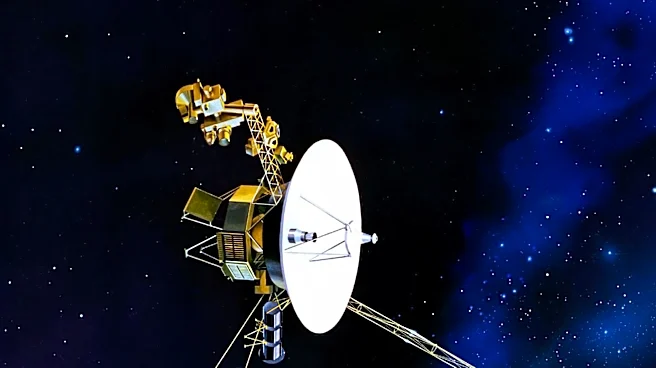
Voyager 1, a spacecraft launched by NASA, crossed the heliopause, the boundary marking the edge of the Sun's protective bubble, and entered interstellar space on August 25, 2012. This transition was marked by a significant drop in low-energy particles
from the Sun and a rise in galactic cosmic rays, indicating the spacecraft was sampling interstellar space. However, contrary to expectations, the magnetic field did not exhibit the anticipated rotation, remaining largely unchanged. This unexpected behavior has puzzled scientists, as the magnetic field was expected to align with the interstellar magnetic field. The boundary Voyager 1 encountered was not a clean surface but a layered and porous structure, challenging existing models of the solar system's edge.
Why It's Important?
The findings from Voyager 1 challenge existing scientific models of the heliopause and the transition into interstellar space. The unexpected magnetic field behavior suggests that the boundary between the solar system and interstellar space is more complex than previously thought. This has significant implications for our understanding of the solar system's structure and the interaction between solar and interstellar magnetic fields. The data from Voyager 1, along with subsequent observations from Voyager 2, which crossed the heliopause in 2018, provide critical insights into the nature of this boundary, prompting a reevaluation of theoretical models and enhancing our understanding of the solar system's interaction with the broader galaxy.
What's Next?
As both Voyager spacecraft continue their journey through interstellar space, scientists are keenly observing for any changes in the magnetic field that might align with theoretical predictions. The spacecraft are running low on power, with instruments being turned off gradually to extend their operational life. The scientific community is awaiting further data that could provide additional insights into the magnetic field's behavior and the structure of the heliopause. The ongoing analysis of data from both Voyager 1 and Voyager 2 will continue to inform and refine models of the solar system's boundary, potentially leading to new discoveries about the nature of interstellar space.