


What's Happening?
Ukraine's Ministry of Defence reported a significant increase in the use of unmanned ground vehicles (UGVs) for logistics and evacuation missions. In October 2026, the military recorded 31,398 such missions, a substantial rise from approximately 7,500
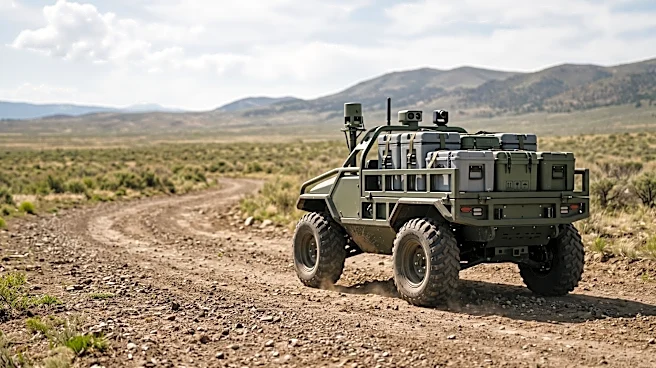
in January of the same year. This data, collected through Ukraine's DELTA battlefield management system, indicates a sustained growth in ground robot deployments throughout 2026. UGVs are primarily used to transport ammunition, food, water, and other supplies to forward positions, thereby reducing personnel exposure to enemy fire and unmanned aerial systems. They also play a crucial role in casualty evacuation from hazardous areas. The expansion of UGV operations is supported by increased domestic manufacturing and procurement, with over 22,000 domestically manufactured UGVs contracted and 67 new robotic models authorized for operational use in 2026. New UGV designs, such as the Varkhan 4x4 for heavy cargo and amphibious platforms, are expanding operational capabilities, allowing for transport across difficult terrain and water obstacles.
Why It's Important?
The increased deployment of UGVs signifies a critical shift in military logistics and casualty management, enhancing the safety of personnel and improving operational efficiency on the battlefield. By utilizing ground robots for supply transport and evacuation, Ukraine can mitigate risks to its soldiers in high-threat environments, which are increasingly characterized by enemy drones and artillery. This technological adoption also highlights Ukraine's growing domestic defense industry capabilities, as the country is developing and manufacturing these advanced systems. The focus on dual-use technologies, where solutions for critical infrastructure protection and autonomous logistics can serve both civilian and military purposes, positions Ukraine as a potential co-architect in European defense systems. This innovation could lead to more resilient and adaptable defense strategies, reducing reliance on traditional, often slower, supply chains and human-intensive operations.
What's Next?
The trend of increasing UGV deployment is expected to continue, with further advancements in robotic capabilities and integration into broader military operations. The Ukrainian Ministry of Defence's approval of new platforms like the Varkhan 4x4 and amphibious UGVs suggests a continuous effort to diversify and specialize the UGV fleet for various battlefield requirements. Future developments will likely focus on improving propulsion efficiency, payload stability, battery endurance, and communications reliability, especially under electronic warfare interference. The ongoing domestic manufacturing drive indicates a strategic intent to achieve greater self-sufficiency in defense technology. Furthermore, Ukraine's experience with these systems could foster international collaborations, particularly with European partners, to develop joint industrial projects in autonomous logistics and robotics, contributing to collective security frameworks.
Beyond the Headlines
The rapid adoption and innovation in UGV technology in Ukraine underscore a broader transformation in modern warfare, moving towards more autonomous and remote operations. This shift has profound implications for military doctrine, personnel training, and the ethical considerations surrounding automated systems in combat. The ability to quickly adapt and deploy new technologies, driven by immediate battlefield needs, demonstrates a dynamic defense ecosystem that prioritizes rapid iteration and integration of feedback from frontline operators. This contrasts with traditional defense procurement cycles, which are often lengthy and less agile. The emphasis on domestic production also fosters national technological sovereignty and resilience, reducing dependence on external suppliers for critical military hardware. This could set a precedent for other nations seeking to modernize their defense capabilities in an increasingly complex geopolitical landscape.