
What's Happening?
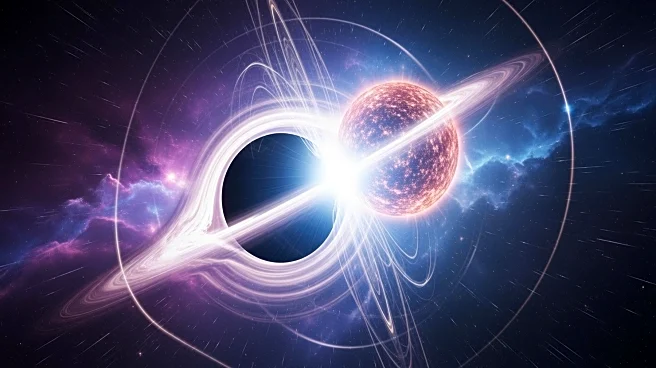
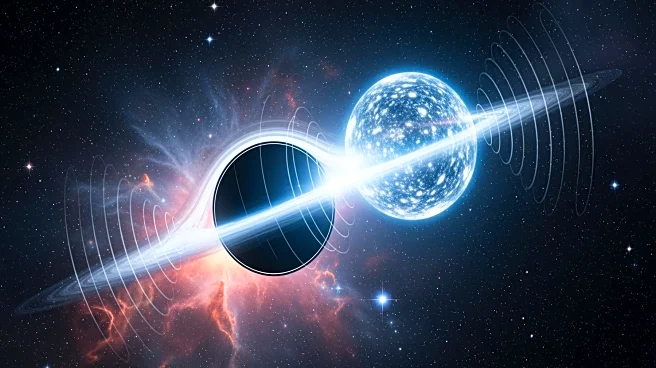
Scientists have discovered a black hole and neutron star collision occurring in an unusual oval orbit, challenging existing theories about such cosmic events. The research, conducted by teams from the University of Birmingham and other institutions, analyzed
gravitational wave data from the LIGO and Virgo detectors. This event, known as GW200105, showed the two celestial bodies merging while still in an elliptical orbit, a first in such observations. The findings suggest that these systems may form in crowded stellar environments, influenced by gravitational interactions with other stars.
Why It's Important?
This discovery is crucial as it challenges the prevailing notion that neutron star-black hole pairs settle into circular orbits before merging. The findings imply that multiple formation pathways exist for these cosmic events, which could reshape our understanding of how such systems evolve. As gravitational wave detectors continue to improve, more unusual systems may be discovered, providing further insights into the dynamics of the universe. This research also highlights the importance of revisiting theoretical models to accommodate new data, potentially leading to a more comprehensive understanding of cosmic mergers.