








What's Happening?
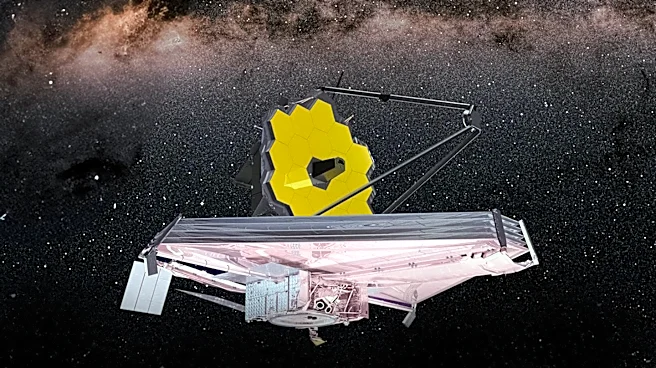
NASA's James Webb Space Telescope has discovered a new planet, Beta Pictoris d, in the Beta Pictoris system, located 63 light-years from Earth. The discovery was made while studying the atmosphere of the known planet Beta Pictoris b. The new planet was identified
through its molecular fingerprint, revealing its presence despite being obscured by a bright debris disk. This finding demonstrates the capabilities of the Webb Telescope in detecting hidden celestial bodies.
Why It's Important?
The discovery of Beta Pictoris d highlights the advanced capabilities of the James Webb Space Telescope in exploring distant star systems. By identifying planets through their molecular signatures, Webb can detect celestial bodies that are otherwise hidden by surrounding debris. This method of discovery opens new possibilities for studying exoplanets and understanding the formation and evolution of planetary systems. The ability to detect faint planets in complex environments enhances our knowledge of the universe and informs future astronomical research.
Beyond the Headlines
The identification of Beta Pictoris d suggests that other hidden planets may exist in similar systems, waiting to be discovered through advanced observational techniques. This discovery also emphasizes the importance of combining data from different telescopes and instruments to confirm findings and build a comprehensive understanding of distant star systems. As astronomers continue to explore the cosmos, the Webb Telescope's capabilities will play a crucial role in uncovering new insights into the universe's structure and composition.