


What's Happening?
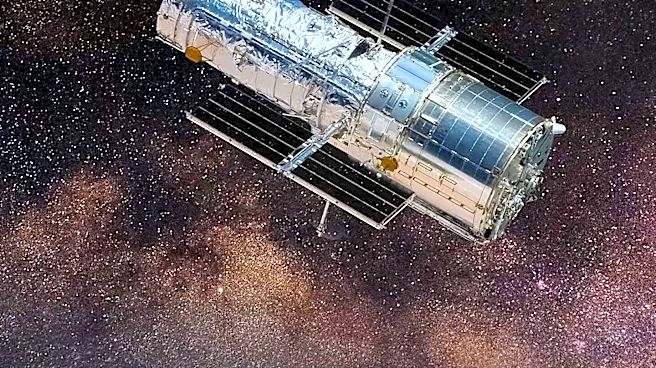
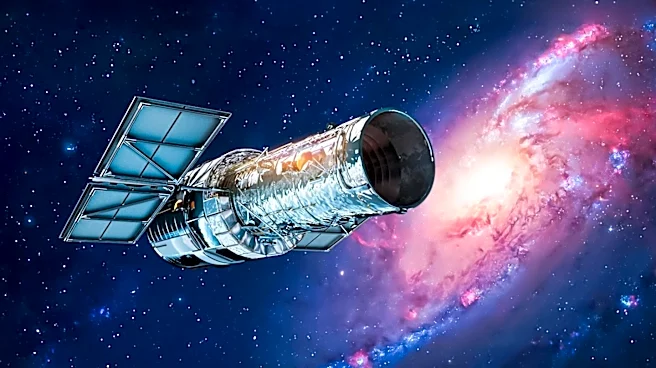
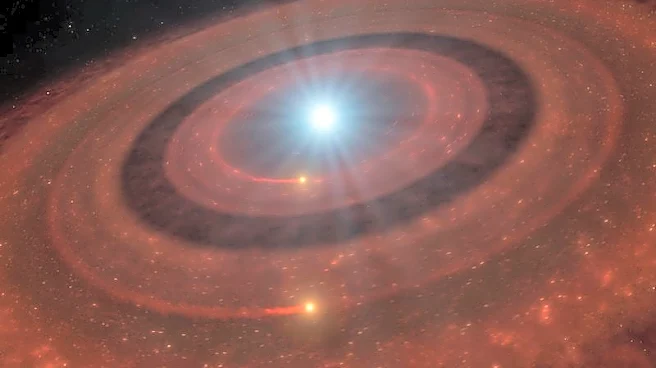
The Hubble Space Telescope has captured the first visible-light view of a faint dust streak, dubbed the 'Cat's Tail,' near the young star Beta Pictoris. This streak, previously only detected in infrared by the James Webb Space Telescope, is believed to be the aftermath
of a collision between two large icy worlds, each roughly the size of Pluto's moon Charon or Makemake. The 'Cat's Tail' is composed almost entirely of dark, carbon-rich organic refractory material, which absorbs visible light, explaining its elusiveness to visible-light observations until now. Arin Avsar, a doctoral student at the Lunar and Planetary Laboratory of the University of Arizona, led the new study, which involved stacking Hubble images taken between 2012 and 2025 to achieve the deepest view of the system to date. The faintness of the tail in visible light, compared to its infrared brightness, suggests its unique composition and porous dust grains.
Why It's Important?
This discovery significantly advances our understanding of planetary formation and the dynamics of debris disks around young stars. The identification of the 'Cat's Tail' as carbon-rich material provides crucial insights into the composition of planetesimals in other star systems, potentially mirroring the early stages of our own solar system. The finding that the dust grains are extremely porous challenges existing models of dust formation and evolution in space. By analyzing the tail's composition and faintness, scientists can infer the size and nature of the colliding bodies, offering a glimpse into the violent processes that shape nascent planetary systems. This research also highlights the complementary capabilities of different telescopes, with Hubble's visible-light observations confirming and expanding upon Webb's infrared findings, providing a more complete picture of cosmic phenomena.
What's Next?
Future research will focus on developing more detailed computer models to understand how such porous, carbon-rich dust grains form and to precisely determine the orientation of the 'Cat's Tail' in three-dimensional space. Deeper Hubble observations are planned for the Beta Pictoris system to further investigate faint smudges and confirm whether they are real dust or imaging artifacts. Astronomers will also continue to refine models of how starlight interacts with different types of dust to better understand the separation of rocky and carbon-rich debris after collisions. The insights gained from this study could inform future missions designed to explore exoplanetary systems and search for signs of planetary formation.
Beyond the Headlines
The 'Cat's Tail' discovery has broader implications for understanding the prevalence of carbon-rich materials in the early universe and their role in the formation of planets. The extreme porosity of the dust grains raises fundamental questions about the physical processes occurring during high-velocity collisions in space, potentially involving vaporization and recondensation of materials. This research also underscores the ongoing evolution of our understanding of debris disks, which are not merely static rings of dust but dynamic environments shaped by gravitational interactions with planets and violent collisions. The lopsided and warped halo around Beta Pictoris, potentially influenced by giant planets, further emphasizes the complex interplay of forces in these young stellar systems, offering a window into the chaotic yet creative processes of cosmic construction.