


What's Happening?
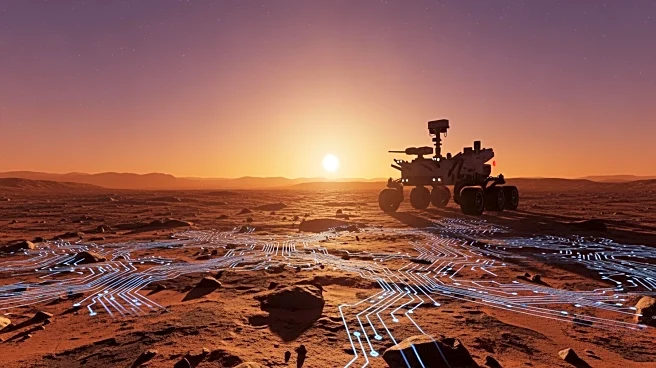
NASA's Perseverance Mars rover has successfully completed its first drives on Mars that were planned using artificial intelligence. These drives, executed on December 8 and 10, 2025, were part of a demonstration led by NASA's Jet Propulsion Laboratory
(JPL) in Southern California. The initiative utilized generative AI to create waypoints for the rover, a task traditionally performed by human planners. This advancement showcases the potential of autonomous technologies to enhance mission efficiency and scientific return, especially as missions venture further from Earth. The AI employed vision-language models to analyze data from JPL's surface mission dataset, generating waypoints that allowed Perseverance to navigate the challenging Martian terrain safely. The project was a collaboration with Anthropic, using their Claude AI models, and was managed by JPL's Rover Operations Center.
Why It's Important?
The successful implementation of AI in planning rover routes on Mars marks a significant advancement in space exploration technology. This development could lead to more efficient and autonomous operations for future missions, reducing the need for real-time human intervention. As Mars is approximately 140 million miles from Earth, communication delays make real-time control challenging. By leveraging AI, missions can operate more independently, potentially increasing the scientific yield and safety of operations. This technology could also pave the way for more complex missions, including those involving human presence on Mars, by providing reliable autonomous navigation and decision-making capabilities.
What's Next?
The integration of AI in rover operations is expected to continue evolving, with future missions likely to incorporate more advanced autonomous systems. These systems could handle longer drives and more complex tasks, further minimizing the workload on human operators. The success of this demonstration may lead to broader applications of AI in other areas of space exploration, such as drones and surface elements on other celestial bodies. NASA and its partners will likely continue to refine these technologies, aiming to establish the infrastructure necessary for sustained human exploration of the Moon and Mars.