


What's Happening?
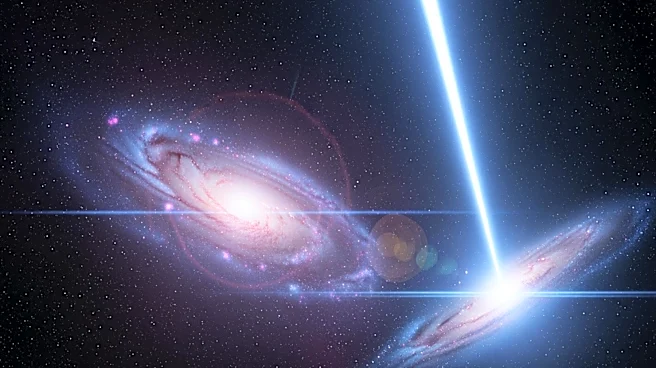
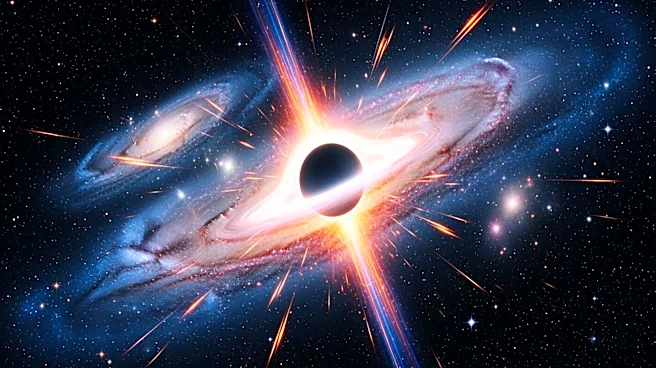
Astronomers have observed a supermassive black hole in galaxy J1007+3540 erupting after being dormant for nearly 100 million years. The event, likened to a 'cosmic volcano,' was captured in radio images showing jets of magnetized plasma being distorted
by the surrounding galaxy cluster. The study, published in the Monthly Notices of the Royal Astronomical Society, reveals the episodic nature of the black hole's activity, with cycles of eruptions shaping the galaxy's structure over cosmic timescales.
Why It's Important?
This discovery provides valuable insights into the behavior of supermassive black holes and their impact on galaxy evolution. Understanding the cycles of black hole activity helps scientists learn how galaxies grow and change over time. The interaction between the jets and the surrounding environment offers clues about the dynamics of galaxy clusters and the role of black holes in cosmic evolution. This research contributes to the broader understanding of astrophysical phenomena and the forces shaping the universe.
What's Next?
Researchers plan to conduct more detailed observations using higher resolution instruments to study the central region of J1007+3540. These efforts aim to track the movement of the newly restarted jets and further understand the interaction between the black hole and its environment. Continued study of such systems will enhance knowledge of black hole cycles and their influence on galaxy formation and evolution.