

What's Happening?
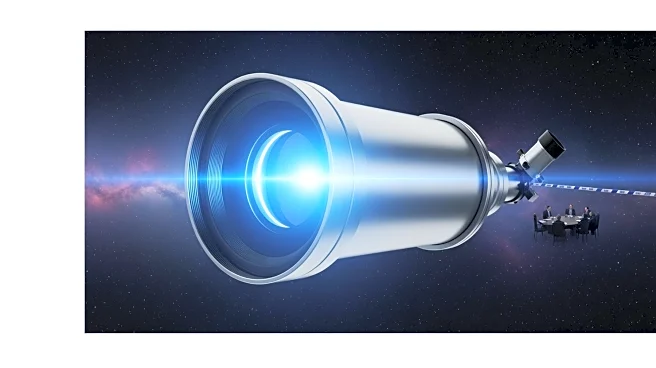
A recent study published in Physical Review Letters proposes that primordial black holes (PBHs) could be responsible for the detection of an extremely energetic neutrino by the Cubic Kilometre Neutrino Telescope (KM3NeT) in 2023. This neutrino, named
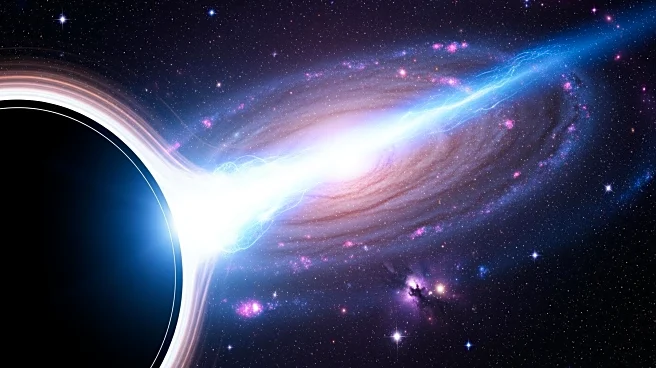
KM3-230213A, was detected at 220 PeV, a level of energy far exceeding that produced by the Sun or even the Large Hadron Collider. The study, led by Michael Baker from the University of Massachusetts, Amherst, suggests that PBHs, which are hypothetical black holes formed shortly after the Big Bang, could emit Hawking Radiation as they evaporate, leading to explosive events that produce high-energy neutrinos. The research highlights the potential of PBHs with a 'dark charge' to explain the phenomenon, as these PBHs could exist in a quasi-extremal state, allowing them to emit such high-energy particles.
Why It's Important?
The study's findings could have significant implications for our understanding of the universe and the fundamental physics governing it. If PBHs are indeed responsible for the high-energy neutrinos, it would provide evidence for the existence of these hypothetical objects, which have been a topic of theoretical physics for decades. This could also offer insights into the early universe's conditions and the nature of dark matter, as PBHs are considered potential dark matter candidates. Furthermore, the ability to detect and study such high-energy neutrinos could advance our knowledge of cosmic phenomena and the processes occurring in the universe's most extreme environments.
What's Next?
The research suggests that further observations and detections of high-energy neutrinos could help confirm the existence of PBHs and their role in cosmic events. The study also points to the need for more sensitive detection equipment, as current observatories like IceCube have not detected neutrinos at the energy levels observed by KM3NeT. Future advancements in neutrino detection technology and continued research into PBHs could provide more definitive answers and potentially reshape our understanding of cosmic physics.