


What's Happening?
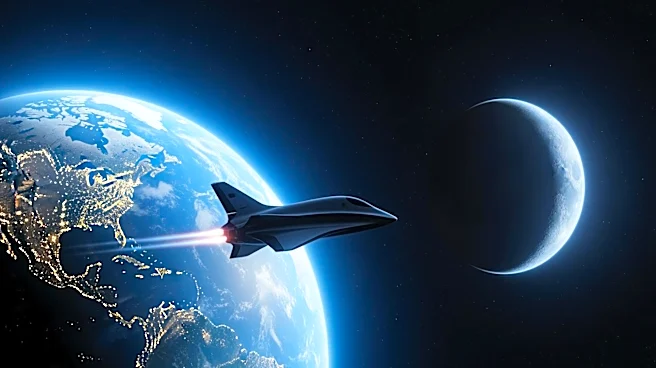
NASA's Artemis II mission has achieved a significant milestone as the crew, consisting of NASA astronauts Reid Wiseman, Victor Glover, Christina Koch, and Canadian Space Agency astronaut Jeremy Hansen, set a new record for the farthest distance traveled
from Earth by a human mission. This surpasses the previous record set by Apollo 13 in 1970. The mission, which involves a lunar flyby, is part of NASA's efforts to explore the Moon's surface and gather scientific data. The crew is tasked with observing and studying lunar features, including the Orientale and Hertzsprung basins, to gain insights into the Moon's geological history. The mission is being broadcast live on various platforms, providing the public with real-time updates and views of the Moon.
Why It's Important?
The Artemis II mission is a crucial step in NASA's long-term goal of establishing a sustainable human presence on the Moon. By surpassing the Apollo 13 distance record, the mission demonstrates advancements in space travel technology and human endurance in space. The scientific observations made during the mission will enhance our understanding of the Moon's geology and could inform future lunar exploration and potential colonization efforts. The mission also serves as a precursor to future Artemis missions, which aim to land astronauts on the lunar surface and explore the potential for lunar resources.
What's Next?
Following the successful lunar flyby, the Artemis II crew will continue their mission by conducting further observations and experiments. The data collected will be analyzed to refine future mission plans and objectives. NASA is also preparing for subsequent Artemis missions, which will involve landing astronauts on the Moon and establishing a lunar base. These efforts are part of a broader strategy to use the Moon as a stepping stone for future human exploration of Mars and beyond.