








What's Happening?
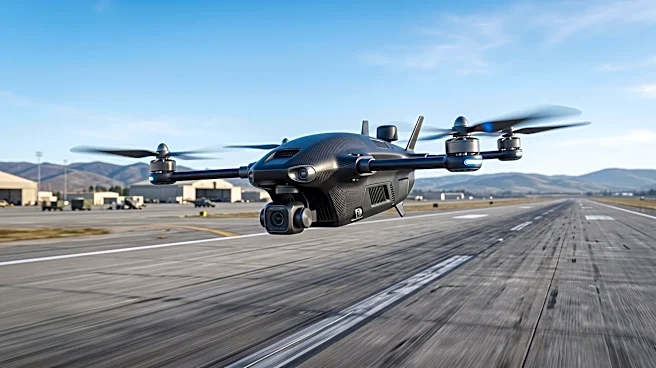
Quantum Systems, a German drone manufacturer, is transitioning from intelligence, surveillance, and reconnaissance (ISR) drones to a full-fledged defense technology company. The company recently hosted 'Forward Edge,' an event in Germany where it showcased
its latest autonomous systems for military applications to hundreds of military and government officials. These demonstrations included coordinated aerial and maritime systems for asset protection, surveillance systems identifying threats and triggering counter-UAS responses, and unmanned ground vehicles in convoy operations. Quantum Systems also announced an unofficial speed record of 777 km/h for its Apex Recordhunter drone, dedicating the achievement to Ukraine. The company, which has significantly expanded its military focus since Russia's invasion of Ukraine, raised $1.2 billion earlier this year at an $8 billion valuation to support this strategic shift. Its expansion plans include the U.S., Australia, Spain, the UK, the Baltics, and Japan, with a stated interest in the 'Taiwan question.'
Why It's Important?
This strategic pivot by Quantum Systems signifies a growing trend in the defense industry towards advanced autonomous systems and integrated defense solutions. The company's rapid development and deployment of military-grade technology, partly driven by lessons from the conflict in Ukraine, highlight the increasing demand for sophisticated unmanned capabilities. The focus on speed, autonomy, and AI integration in defense systems could reshape modern warfare tactics and defense procurement strategies globally. For the U.S. and its allies, this development points to potential new avenues for collaboration in defense technology, as well as increased competition in the global arms market. The emphasis on rapid prototyping and iteration, a departure from traditional defense development cycles, could also influence how defense contractors approach innovation and product delivery, potentially accelerating the introduction of new technologies to the battlefield.
What's Next?
Quantum Systems aims to have its upgraded equipment fully operational by the end of the year, with further testing and real-world implementation planned. The company is also developing a C-UAS system in partnership with Ukraine's Frontline Robotics, with significant orders already placed, indicating continued collaboration and deployment in active conflict zones. Its armored drone, the Pulse P19, is slated for its first flight in mid-2027, pending regulatory approvals. Quantum Systems plans to continue its international expansion, establishing a stronger presence in key markets like the U.S. and Japan. The company's ongoing investment in AI-based mission software, Mosaic, suggests a future where autonomous systems play an even more central role in military operations, with continuous software refreshes every six weeks and hardware updates every 12 weeks to adapt to evolving threats.
Beyond the Headlines
The shift by Quantum Systems towards full military defense tech, with its motto 'The future is unmanned,' raises significant ethical and strategic questions about the increasing autonomy of warfare. While the company states that humans will always have the ability to override AI systems, the rapid advancement of AI in defense necessitates ongoing discussions about regulation and control. The reliance on private companies for critical defense infrastructure, as highlighted by concerns over satellite communication control, also brings into focus issues of national sovereignty and technological dependence. Europe's push for greater self-reliance in defense technology, as articulated by Quantum Systems' co-CEO Florian Seibel, suggests a potential long-term shift away from reliance on external powers for critical military capabilities, fostering a more vertically integrated and sovereign defense industrial base within the continent.