



What's Happening?
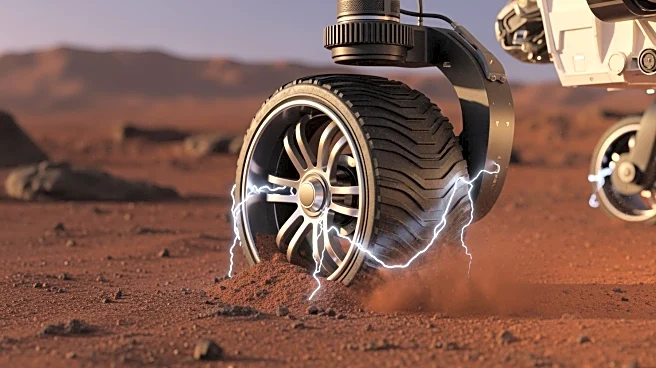
NASA's Perseverance rover and MAVEN orbiter have detected signals suggesting possible electrical discharges on Mars. The Perseverance rover recorded crackling sounds during dust storms, which researchers believe are caused by small electrical discharges within
charged dust clouds. Meanwhile, MAVEN detected a rare radio 'whistler' signal, indicative of lightning, in data collected in June 2015. Mars has a thin atmosphere and scattered magnetic fields, making lightning detection challenging. These findings suggest that Mars may host faint electrical sparks generated by swirling, electrostatically charged dust.
Why It's Important?
The discovery of electrical discharges on Mars could have significant implications for understanding the planet's atmospheric chemistry and potential for life. On Earth, lightning sparks chemical reactions that may contribute to the development of life. If similar processes occur on Mars, it could provide insights into the planet's chemical environment and its ability to support life. Additionally, these findings could influence future Mars missions, as understanding electrical phenomena is crucial for designing equipment that can withstand such conditions.
What's Next?
NASA's MAVEN orbiter has been out of contact for nearly three months, leaving questions about future observations. Researchers are eager to continue studying Mars' electrical activity to confirm these findings and explore their implications further. The European Space Agency (ESA) plans to launch a new lander in 2028, but it will not include a lightning detector, which could have provided more data on Mars' electrical phenomena. Scientists will continue to analyze existing data and seek opportunities to gather more evidence of electrical activity on Mars.
Beyond the Headlines
The detection of electrical discharges on Mars highlights the planet's complex atmospheric dynamics. Understanding these phenomena could lead to new insights into Mars' weather patterns and climate. Additionally, the findings raise questions about the potential for varied electrical phenomena on Mars, similar to those on Earth, such as Saint Elmo's fire. This research could also inform the design of future Mars missions, ensuring that equipment is prepared to handle electrical activity.