
What's Happening?
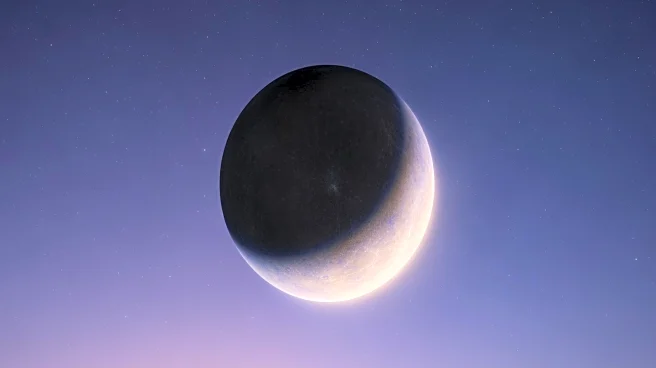
Mercury is becoming increasingly visible in the predawn sky as it approaches its greatest western elongation from the Sun. Currently, the planet is 7° high an hour before sunrise, shining at a magnitude
of -0.3 with a 54% illuminated disk. Mercury will reach its greatest elongation on December 7, standing 21° from the Sun. This period offers a prime opportunity for skywatchers to observe the elusive planet, which is often difficult to see due to its proximity to the Sun.
Why It's Important?
Observing Mercury during its greatest elongation provides a rare chance for astronomers and enthusiasts to study the planet's characteristics and behavior. Mercury's visibility is typically limited due to its close orbit around the Sun, making this event significant for both scientific research and public engagement with astronomy. The planet's increased brightness and visibility offer an opportunity to observe its phases and surface features, contributing to our understanding of the innermost planet in the solar system.
What's Next?
Following its greatest elongation, Mercury will gradually move closer to the Sun, becoming less visible in the morning sky. Observers are encouraged to take advantage of the current visibility to study the planet. Future elongations will provide additional opportunities for observation, but the current event is particularly favorable due to Mercury's brightness and position in the sky.