



What's Happening?
New research co-led by MIT chemistry professor Mei Hong and Professor of Planetary Sciences Sara Seager, published in the Proceedings of the National Academy of Sciences, indicates that short peptide chains can survive and even fold into functional shapes
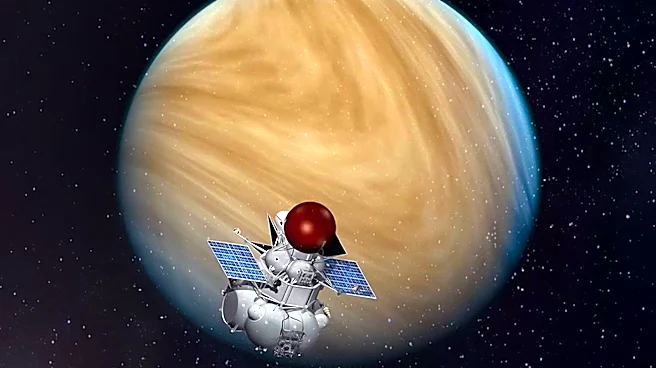
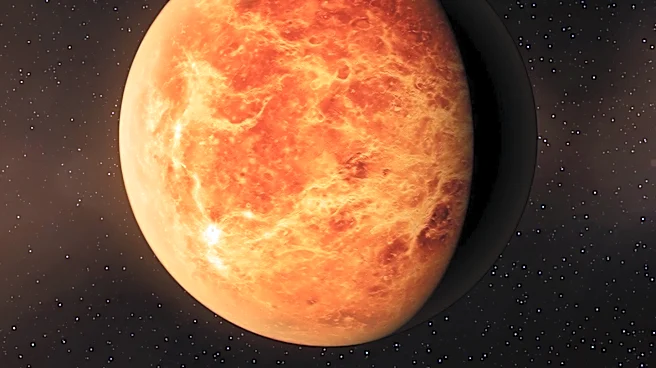
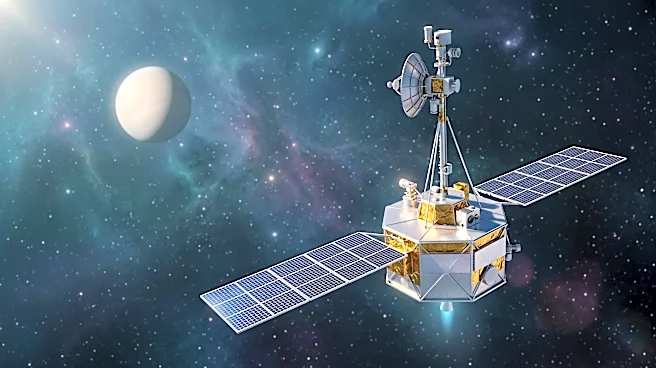
within highly concentrated sulfuric acid solutions, conditions previously thought to be lethal to organic molecules. This discovery challenges the long-held assumption that Venus's atmosphere is chemically inhospitable to life's building blocks. While the surface of Venus is extremely hot and pressurized, its cloud deck, 30 to 40 miles up, offers milder temperatures alongside near-pure sulfuric acid. Meteorites regularly deliver organic peptides into this upper atmosphere, leading to debates among planetary scientists about their persistence. The MIT team used nuclear magnetic resonance spectroscopy to monitor three short peptides in a 98% sulfuric acid solution, finding they remained intact for weeks due to the absence of water, which prevents hydrolysis—the typical reaction that breaks peptide bonds. Furthermore, all three peptides folded into an omega loop shape, suggesting structural stability and potential for biological functions.
Why It's Important?
This research significantly broadens the scope of where extraterrestrial life might be found, particularly within extreme environments. By demonstrating that complex organic molecules can not only survive but also maintain functional structures in Venus's sulfuric acid clouds, scientists are forced to reconsider the criteria for habitability. This could lead to a re-evaluation of Venus as a potential site for life, shifting focus from the planet's inhospitable surface to its atmospheric layers. The findings have implications for astrobiology and the search for life beyond Earth, suggesting that life might adapt to and thrive in conditions previously deemed impossible. It also highlights the importance of understanding the specific chemical mechanisms at play in different environments, as the absence of water, rather than the presence of acid, proved crucial for peptide stability in this case. This could guide future missions and observational strategies for Venus and other planets with similar atmospheric compositions.
What's Next?
Seager’s team plans to conduct further experiments, testing longer amino acid chains and peptide nucleic acid (a synthetic analogue to DNA) to determine if more complex genetic architectures can withstand similar stress. This will help ascertain the limits of molecular stability in extreme conditions and whether more advanced biological processes could occur. Independent scientists, such as structural biologist Ad Bax, emphasize that while these results show protein-like shapes can endure harsh conditions, establishing actual life on Venus still requires more evidence. The research does not claim the discovery of extraterrestrial life but rather demonstrates that acid chemistry does not entirely rule out Venus as a potential host for life. Future investigations will likely focus on identifying other potential biosignatures or more complex organic structures within Venus's atmosphere, potentially leading to new missions or observational studies.
Beyond the Headlines
The study's implications extend beyond Venus, influencing our understanding of life's resilience and adaptability across the cosmos. If life's building blocks can persist and function in such extreme conditions, it suggests that the universe might harbor life in a wider variety of environments than previously imagined. This could fundamentally alter our search strategies for exoplanets and moons, encouraging scientists to look beyond Earth-like conditions. Ethically, this research prompts deeper philosophical questions about the definition of life and its potential forms, challenging anthropocentric views of biological existence. It also underscores the iterative nature of scientific discovery, where new experimental data can overturn long-standing assumptions and open entirely new avenues of inquiry in the quest to understand our place in the universe.