







What's Happening?
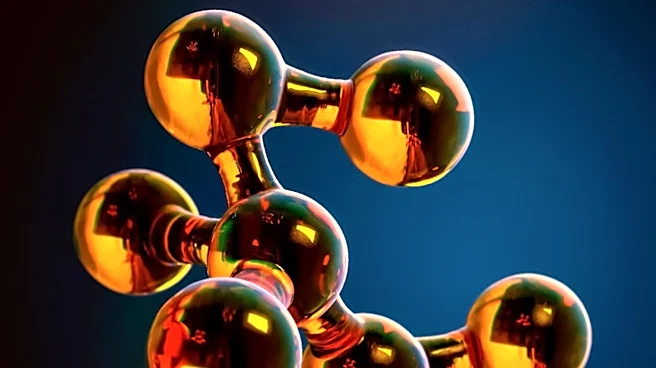
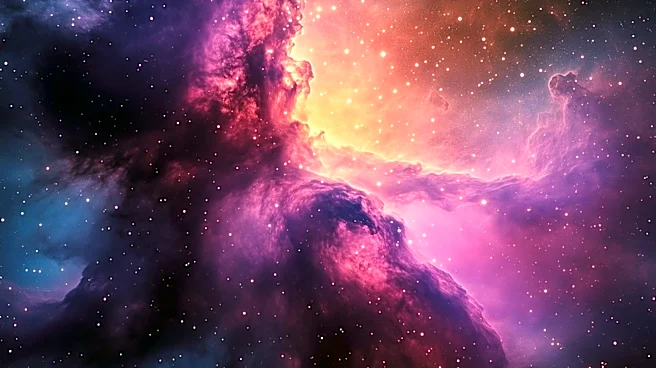
Astronomers have discovered traces of erythrulose, a type of sugar found in fruits like raspberries and kiwis, in a giant gas cloud near the center of the Milky Way. This marks the first time sugar, a key ingredient for life, has been detected in interstellar
space. The discovery was detailed in a study published in the journal Nature Astronomy. The presence of erythrulose challenges the prevailing belief that sugars form gradually by adding one carbon atom at a time. Instead, it suggests a formation process involving two organic molecules containing a carbon pair. This finding opens up the possibility for life to develop on other worlds in a similar fashion to Earth.
Why It's Important?
The detection of erythrulose in space is significant for astrobiology as it suggests that sugars, essential for life, are more common in the universe than previously thought. Sugars like ribose and deoxyribose form the backbone of RNA and DNA, which are crucial for life. The presence of such sugars in space implies that the building blocks of life could be widespread, increasing the potential for life to exist elsewhere in the universe. This discovery could reshape our understanding of how life might develop on other planets, providing new insights into the origins of life on Earth and beyond.
What's Next?
Future research will likely focus on further exploring the formation processes of sugars in space and their potential role in the development of life. Scientists may use advanced telescopes and techniques to search for other complex organic molecules in interstellar space. This could lead to a better understanding of the chemical processes that occur in molecular clouds and their implications for astrobiology. Additionally, the study of these sugars could inform the search for life on exoplanets, guiding future missions and research in the field of space exploration.