




What's Happening?
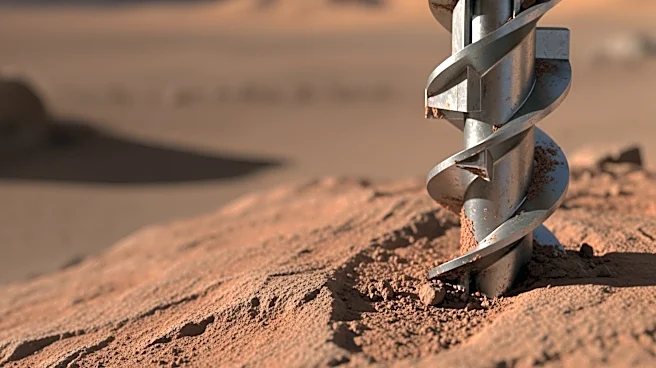
NASA's Curiosity Mars rover encountered a challenge when a rock, nicknamed 'Atacama,' became lodged in its drill on April 25, 2026. The rover's team at NASA's Jet Propulsion Laboratory worked diligently to dislodge the rock by repositioning the robotic
arm and vibrating the drill. The rock was successfully detached on May 1, 2026. The rock, estimated to be 1.5 feet in diameter and 6 inches thick, weighed approximately 28.6 pounds on Earth. The incident occurred on the 4,877th Martian day of the mission, highlighting the ongoing challenges faced by the rover as it continues its exploration of Mars. The Curiosity rover, managed by Caltech in Pasadena, California, is part of NASA's Mars Exploration Program, and the Mast Camera used to capture images of the rock was built by Malin Space Science Systems in San Diego.
Why It's Important?
The successful removal of the rock from Curiosity's drill is significant for the continuation of the rover's mission on Mars. The ability to overcome mechanical challenges ensures that the rover can continue to collect valuable scientific data about the Martian surface. This incident underscores the importance of engineering solutions in space exploration, where remote problem-solving is crucial. The Curiosity rover has been instrumental in advancing our understanding of Mars, and maintaining its operational capabilities is vital for ongoing research. The rover's ability to adapt and overcome obstacles contributes to the broader goals of NASA's Mars Exploration Program, which aims to gather insights into the planet's geology and potential for past life.