






What's Happening?
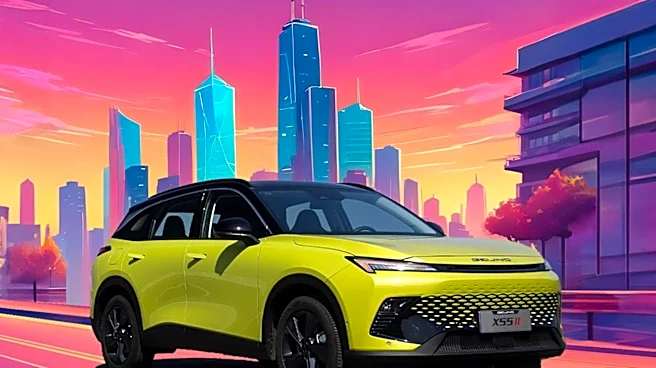
The Alliance for Automotive Innovation (Auto Innovators) has formally requested the U.S. House and Senate to enact a permanent ban on the sale, import, and manufacturing of Chinese connected vehicles, hardware, and software before the conclusion of the 119th
Congress. According to Repairer Driven News, Auto Innovators CEO John Bozzella stated that Chinese automakers are 'dumping subsidized vehicles with connected software and hardware around the world,' which are capable of collecting and transmitting sensitive data to the Chinese Communist Party. This call to action supports existing bipartisan legislative efforts, including the Connected Vehicle Security Act of 2026, introduced by Senator Bernie Moreno (R-Ohio) and Elissa Slotkin (D-Michigan), and its companion bill, H.R. 8730, filed by U.S. Representatives John Moolenaar (R-Michigan) and Debbie Dingell (D-Michigan).
Why It's Important?
This initiative is critical for U.S. national security and economic stability, as it addresses the potential for foreign adversaries, particularly China, to compromise sensitive data through connected vehicles. The integration of advanced technology in modern vehicles means they can collect vast amounts of personal and operational data, making them potential tools for espionage or cyberattacks. A ban would protect American consumers' privacy and safeguard critical infrastructure from potential foreign interference. Economically, it aims to counter unfair trade practices and intellectual property theft by China, which Auto Innovators argues undermines the U.S. automotive manufacturing sector, a significant employer and economic driver. The bipartisan support for these bills underscores the widespread concern across the political spectrum regarding China's technological ambitions and their implications for U.S. interests.
What's Next?
Congress is expected to continue debating and advancing legislation aimed at banning Chinese connected vehicles and related components. The Auto Innovators' letter will likely add pressure on lawmakers to prioritize these bills. Discussions will focus on the scope of the ban, including definitions of 'Chinese ownership' and potential impacts on international trade relations. For instance, concerns have been raised that a section of the Connected Vehicle Security Act could inadvertently affect non-Chinese manufacturers with partial Chinese ownership, such as Mercedes-Benz. Lawmakers will need to refine the legislation to achieve its security objectives without causing unintended economic disruptions. Additionally, the U.S. Department of Commerce's Bureau of Industry and Security (BIS) has already implemented rules banning Chinese and Russian connected vehicle technology, and Congress's actions will build upon these existing regulatory frameworks.
Beyond the Headlines
The push to ban Chinese connected vehicles highlights a broader geopolitical struggle for technological dominance and data sovereignty. As vehicles become increasingly connected and autonomous, they transform into mobile data centers, making their security paramount. This issue extends beyond mere economic competition, touching upon fundamental questions of trust in global supply chains and the protection of national interests in an interconnected world. The debate also reflects the growing awareness of the dual-use nature of technology, where innovations designed for convenience can also be exploited for surveillance or strategic advantage. The outcome of these legislative efforts will not only shape the future of the U.S. automotive industry but also set precedents for how democratic nations address the security implications of technology originating from geopolitical rivals, potentially influencing international standards and trade policies for years to come.