
What's Happening?
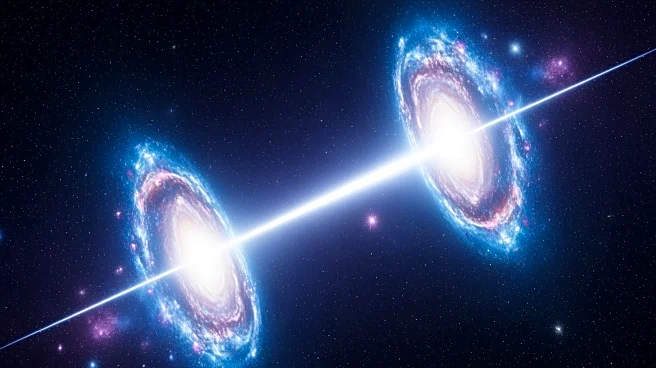
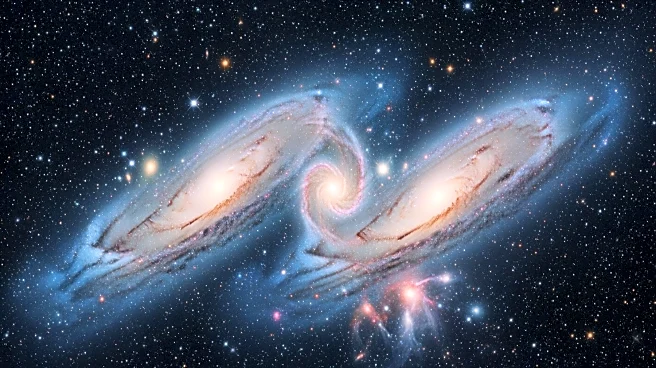
Astronomers have identified the most distant and brightest 'space laser,' or megamaser, ever observed, emanating from a galaxy collision that occurred 8 billion light-years away. This phenomenon, known as a hydroxyl megamaser, was detected using the MeerKAT
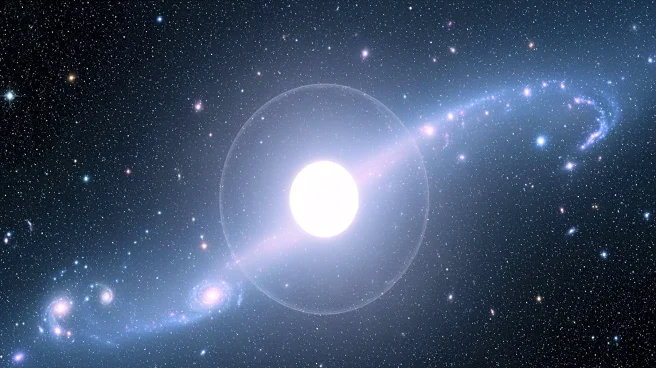
radio telescope in South Africa. The megamaser is a result of hydroxyl molecules colliding within the dense gas of merging galaxies. The discovery is significant due to the gravitational lensing effect, which magnifies the light from the distant event, making it visible to astronomers. This effect, first predicted by Einstein's theory of general relativity, allows scientists to study such distant cosmic events. The presence of the megamaser indicates intense molecular activity and star formation within the colliding galaxies.
Why It's Important?
The discovery of this megamaser provides valuable insights into the early universe, particularly regarding galaxy formation and evolution. The gravitational lensing effect not only enhances the visibility of such distant phenomena but also offers a natural magnifying tool for astronomers. This allows for the study of cosmic events that would otherwise be too faint to observe. The presence of hydroxyl megamasers can also indicate dual active galactic nuclei or pairs of supermassive black holes, which are expected to produce gravitational waves. Understanding these processes is crucial for comprehending the dynamics of galaxy mergers and the conditions that lead to intense star formation.
What's Next?
Future observations and studies will likely focus on further analyzing the emission lines from the megamaser to gain deeper insights into the gas kinematics and physical conditions within the galaxy. This could enhance our understanding of the processes driving star formation and the role of megamasers in the early universe. Additionally, astronomers may continue to use gravitational lensing as a tool to discover and study other distant cosmic phenomena, potentially leading to new discoveries about the universe's history and structure.