


What's Happening?
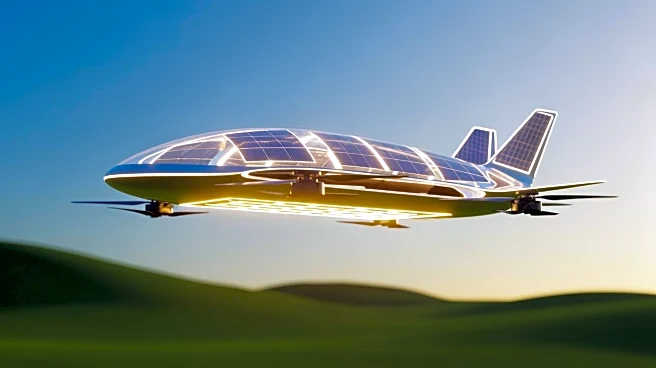
A father-son duo, Mike and Luke Bell, have designed a unique unmanned aerial vehicle that operates entirely on solar power, eliminating the need for traditional batteries. This innovative drone, which holds the Guinness World Record for the fastest quadcopter,
is equipped with 27 solar panels that generate approximately 150 watts of power during ground tests. The drone's structure consists of a large X-frame made from carbon fiber tubing, with 18-inch propellers and lightweight Antigravity motors. It also features a flight controller, 3D-printed mounts, and small cameras that connect to a POV VR headset. The solar panels are mounted on the drone's frame using a support structure made of 3mm carbon fiber tubes. This design allows the drone to potentially fly all day, provided there is sufficient sunlight.
Why It's Important?
The development of a solar-powered drone represents a significant advancement in sustainable technology, offering a glimpse into the future of unmanned aerial vehicles. By eliminating the need for batteries, this drone reduces reliance on lithium and other materials typically used in battery production, which are subject to supply constraints and environmental concerns. The ability to operate continuously during daylight hours without the need for recharging could revolutionize applications in surveillance, environmental monitoring, and agriculture, where extended flight times are beneficial. This innovation also highlights the potential for solar energy to power more complex systems, contributing to the broader adoption of renewable energy solutions.
What's Next?
As solar technology continues to advance, we can expect further improvements in the efficiency and power output of solar panels, which could enhance the performance and capabilities of solar-powered drones. The success of this project may inspire other innovators to explore similar battery-free designs, potentially leading to a new class of sustainable aerial vehicles. Additionally, regulatory bodies may need to consider new guidelines for the operation of solar-powered drones, particularly in terms of airspace management and safety standards. The ongoing development of this technology could also prompt increased investment in research and development of renewable energy-powered devices.