
What's Happening?
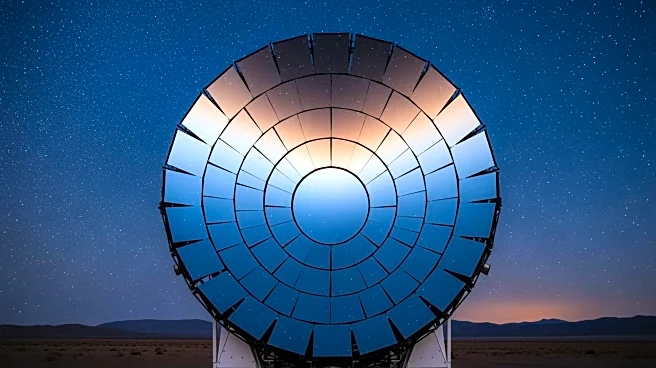
The Giant Magellan Telescope (GMT), a major U.S. astronomical project, continues to progress despite challenges and competition from international counterparts. Originally planned to be operational by
now, the GMT has faced funding and technological hurdles. It is part of a global race to build the next generation of large optical telescopes, with the European Extremely Large Telescope (ELT) advancing rapidly. The GMT, with a 25.4-meter diameter, aims to maintain U.S. competitiveness in astronomy by providing unprecedented observational capabilities. The project is supported by a consortium of U.S. institutions and aims to inspire future generations in science and technology.
Why It's Important?
The development of the Giant Magellan Telescope is crucial for maintaining the United States' leadership in astronomical research. As telescopes become more advanced, they allow scientists to explore deeper into space, providing insights into the universe's origins and the nature of exoplanets. The GMT's progress is vital for U.S. scientific prestige and for inspiring future scientists and engineers. Additionally, the project drives technological innovation, particularly in adaptive optics and detector systems, which have broader applications beyond astronomy. The telescope's success could also influence future funding and support for large-scale scientific endeavors.