
What's Happening?
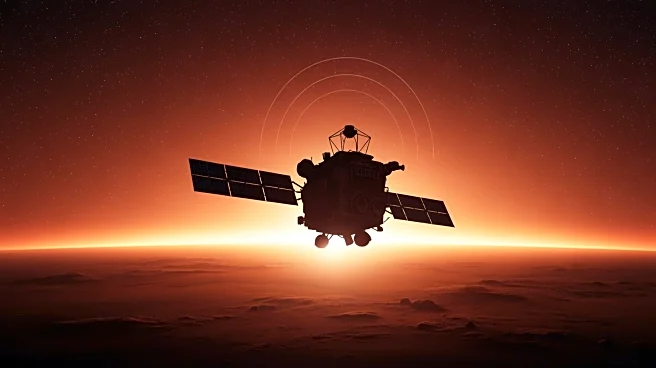
NASA is making renewed efforts to contact the Mars Atmosphere and Volatile Evolution (MAVEN) mission, which has been silent since December 6, 2025. The spacecraft lost communication after a routine maneuver
where Mars temporarily blocked signals to Earth. Despite telemetry indicating normal operations before the blackout, MAVEN was found to be rotating unexpectedly and not in its planned orbit. The situation was exacerbated by a solar conjunction, a period when the sun interferes with radio signals, which ended on January 16, 2026. MAVEN, launched in 2013, plays a crucial role in studying Mars' atmosphere and serves as a communications relay for other Mars missions.
Why It's Important?
MAVEN's silence poses significant challenges for Mars exploration. As a key communications relay, its absence affects data transmission for surface missions like the Curiosity and Perseverance rovers. The loss of MAVEN could hinder scientific research and operational support, impacting the broader Mars exploration program. The situation highlights the vulnerability of space missions to technical failures and the importance of robust backup systems. NASA's reliance on MAVEN underscores the need for continued investment in space infrastructure to ensure mission continuity and scientific progress.
What's Next?
NASA plans to intensify efforts to reestablish contact with MAVEN, although prospects appear dim. The agency has adjusted operations to rely more on other orbiters, such as the Mars Reconnaissance Orbiter and Mars Odyssey, to maintain communication with surface missions. Future steps may involve developing new strategies to mitigate the impact of MAVEN's potential permanent loss. The situation may prompt NASA to accelerate the development of alternative communication technologies and enhance the resilience of its Mars mission infrastructure.