



What's Happening?
U.S. Representative Mark Alford's office announced a $16.2 million federal grant for the City of Columbia, Missouri, to modernize its municipally owned Columbia Terminal Railroad (COLT). This funding, part of the Federal Railroad Administration's Consolidated
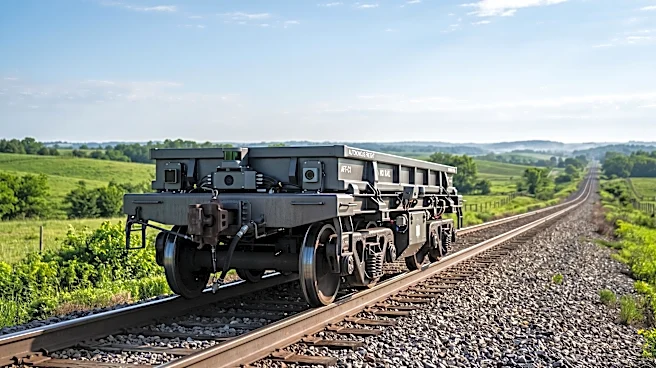
Rail Infrastructure and Safety Improvements (CRISI) program, will support the deployment of two Intramotev TugVolt autonomous railcars. The project aims to test autonomous freight rail operations along the 21.4-mile route between Columbia and Centralia. The total modernization program is valued at $20.827 million, with $4.62 million in non-federal contributions from the city and private partners. The initiative includes significant infrastructure upgrades such as 36,000 composite rail ties, replacement of three turnout switches, track tamping, and the installation of two terminal charging units. Additionally, the project incorporates workforce training for remote operators, field engineers, and maintenance technicians, in collaboration with the American Short Line and Regional Railroad Association.
Why It's Important?
This project is significant as it represents a substantial investment in advanced rail technology and infrastructure within the U.S. It positions Columbia, Missouri, at the forefront of autonomous freight rail testing, potentially setting a precedent for over 600 U.S. short lines. The successful deployment and safety record of the Intramotev TugVolt railcars could provide a template for wider adoption of autonomous rail technology, offering benefits such as increased service frequency and reduced operating costs for short-line operators. For the broader U.S. rail industry, this initiative highlights the critical need for integrated modernization efforts that encompass not only new equipment but also track condition, charging infrastructure, and a skilled workforce. The project's outcomes will be closely watched by federal regulators and other railroad operators as they evaluate the feasibility and safety of autonomous freight transport.
What's Next?
The project will proceed in phases, beginning with remote switching operations at COLT’s Columbia terminal. Subsequent stages will involve progression towards autonomous freight service across the mainline, including public crossings. The two TugVolt units are slated to be built at Intramotev’s St. Louis facility. Key milestones to monitor include the delivery of these railcars, the commencement of remote terminal switching, and progress toward mainline demonstrations. While a specific deployment date or timetable for full-line service transition has not been specified, the project aims to build a documented safety record that can inform future evaluations by the Federal Railroad Administration and other short-line railroads. The workforce training component will also be crucial in preparing personnel for the new operational demands of autonomous rail technology.
Beyond the Headlines
Beyond the immediate technological advancements, this project touches upon broader implications for regional economic development and the future of logistics. By modernizing the Columbia Terminal Railroad, the initiative aims to strengthen service for local businesses that rely on freight transport, potentially enhancing their competitiveness and fostering economic growth in the region. The emphasis on workforce training also addresses the evolving skill requirements in the transportation sector, preparing a new generation of rail professionals for automated systems. Furthermore, the project serves as a real-world case study for integrating cutting-edge automation into existing infrastructure, offering valuable insights into the challenges and opportunities associated with such transitions. The success of this pilot could influence public policy and investment strategies for infrastructure modernization across the nation, promoting efficiency and sustainability in freight movement.