





What's Happening?
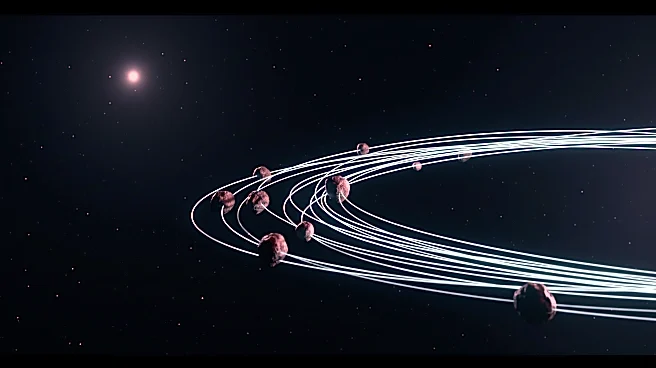
Astronomers may have found the first direct evidence suggesting the existence of Planet Nine, a hypothetical large planet believed to be lurking beyond Neptune. For years, the presence of Planet Nine has been inferred from the unusual clustered and tilted
orbits of several extremely distant objects in the outer Solar System, suggesting they are being gravitationally shepherded by an unseen body. Researchers, led by Terry Long Phan of National Tsing Hua University in Taiwan, analyzed decades-old infrared observations and identified a faint object that moved across the sky between two surveys conducted 23 years apart (IRAS in 1983 and AKARI in 2006-2007). The object's brightness and slow motion are consistent with what would be expected from a large planet located hundreds of times farther from the Sun than Earth, with an estimated mass between 7 and 17 times that of Earth.
Why It's Important?
The potential discovery of Planet Nine would represent a monumental shift in our understanding of the Solar System's architecture and formation. Its existence could explain the anomalous orbits of trans-Neptunian objects, providing a missing piece in the puzzle of our cosmic neighborhood. This finding, if confirmed, would validate years of theoretical predictions and indirect observational evidence. The use of infrared observations is particularly significant because a distant planet would be extremely faint in visible light but would emit detectable heat. This methodology opens new avenues for searching for distant, cold objects in the outer Solar System. Confirming Planet Nine would not only expand our planetary census but also offer crucial insights into the gravitational dynamics that shaped the early Solar System and continue to influence its outermost regions.
What's Next?
The researchers emphasize that this finding is not a definitive discovery of Planet Nine, but rather a strong candidate that requires further investigation. The next crucial step is to conduct additional observations to confirm the object's planetary orbit. Phan and his colleagues suggest using instruments like the Dark Energy Camera on the 4-meter Blanco Telescope in Chile to track the object's movement. Determining a reliable orbit is essential, as Planet Nine must move along a path that can explain the gravitational influence observed on other outer Solar System objects. There are still uncertainties, including a potentially unreliable infrared measurement from AKARI and the reliance on assumptions about Planet Nine's mass, temperature, and distance. Future observations will either confirm this candidate as Planet Nine or rule it out, guiding astronomers in their ongoing search.
Beyond the Headlines
The hunt for Planet Nine embodies the enduring human quest to explore and understand the cosmos. Beyond the scientific implications, the potential discovery challenges our conventional understanding of what constitutes a 'planet' and how many major bodies reside within our own star system. It highlights the vastness and mystery that still exist even in our immediate cosmic backyard. The ethical dimension involves the rigorous scientific process of verification and peer review, ensuring that extraordinary claims are met with extraordinary evidence. If confirmed, Planet Nine could inspire a new generation of planetary science, leading to dedicated missions or advanced telescopic observations to characterize this distant world. It also serves as a reminder that our Solar System, despite centuries of study, may still hold profound secrets waiting to be unveiled.