






What's Happening?
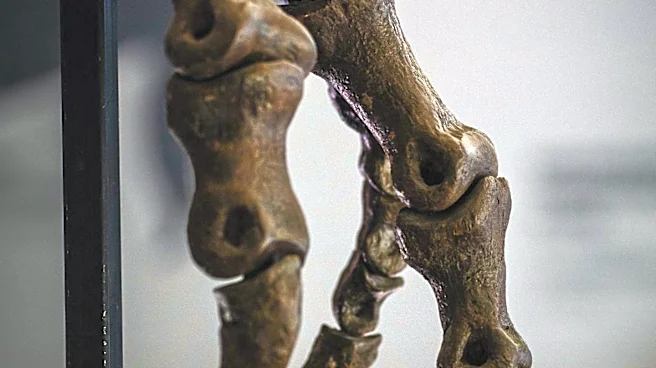
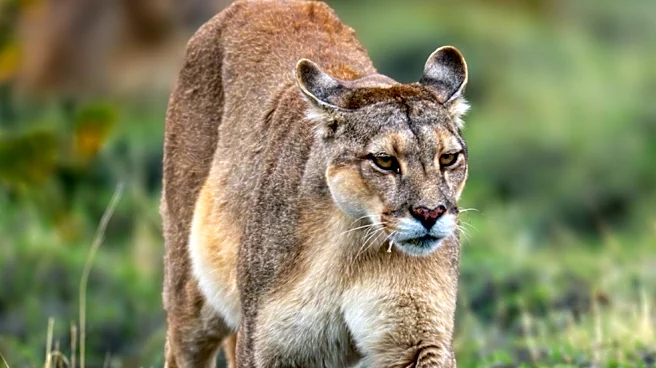
New research published in the journal Current Biology reveals that the extinct North American cat, Miracinonyx trumani, commonly known as the 'American cheetah,' was not a true cheetah but rather more closely related to modern pumas. This discovery challenges
long-held assumptions about the species, which roamed North America during the Pleistocene epoch. Scientists sequenced the most complete ancient DNA data set for M. trumani, including specimens from Wyoming and Canada's Yukon Territory. The genetic analysis showed that M. trumani shared a common ancestor with modern cheetahs approximately 4.7 million years ago but diverged from a common ancestor with pumas about 2.6 million years ago. Furthermore, the study uncovered surprising dietary adaptations, with some populations in the Arctic preying almost exclusively on fish, a stark contrast to the previously assumed diet of fast-running prey like pronghorns.
Why It's Important?
This reclassification of Miracinonyx trumani significantly alters our understanding of North American prehistoric ecosystems and the evolutionary history of felids. By identifying the 'American cheetah' as a puma relative, scientists gain new insights into the diversification of cat species and their adaptive capabilities across diverse environments. The discovery of fish-eating populations in the Arctic highlights the remarkable flexibility and adaptability of this extinct predator, suggesting it could thrive in various ecological niches, from subtropical regions to the extreme conditions of the Arctic. This challenges the traditional view of M. trumani as solely a pursuit predator of large terrestrial game. Understanding such broad dietary and environmental adaptability in an extinct species provides valuable context for studying current species' resilience to environmental changes and offers a more complete picture of the complex food webs that existed during the Pleistocene.
What's Next?
The findings open new avenues for paleontological and genetic research into Miracinonyx trumani and other extinct North American megafauna. Future studies may focus on further analyzing the genetic data to uncover more details about its evolutionary path, population dynamics, and interactions with other species in its ecosystem. Researchers might also investigate the specific mechanisms that allowed M. trumani to adapt to a fish-based diet in the Arctic, potentially revealing unique physiological or behavioral traits. The re-evaluation of this species could also lead to a broader re-examination of other extinct animals that have been categorized based on superficial resemblances to modern species. This research underscores the importance of ancient DNA analysis in refining our understanding of prehistoric life and correcting long-standing scientific assumptions, contributing to a more accurate and nuanced reconstruction of Earth's past biodiversity.
Beyond the Headlines
The story of the 'American cheetah' being reclassified as a puma relative with unexpected Arctic adaptations offers a compelling narrative about the dynamic nature of scientific discovery and the limitations of initial interpretations based solely on morphology. It serves as a reminder that the fossil record, while invaluable, often provides an incomplete picture, and modern scientific techniques like ancient DNA sequencing can revolutionize our understanding. This case also highlights the incredible adaptability of life, demonstrating how a single species could occupy vastly different ecological roles and geographical ranges. The nonfunctional circadian rhythm genes found in M. trumani populations in high latitudes suggest profound evolutionary adjustments to extreme light cycles, offering insights into how animals cope with environmental extremes. This deeper understanding of past adaptations can inform conservation efforts for modern species facing rapid environmental changes, emphasizing the potential for unexpected evolutionary pathways.